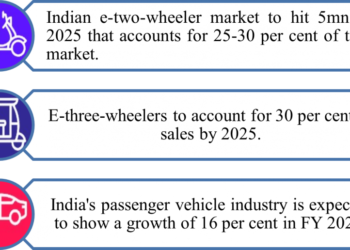
India is accelerating the structural transformation to e-mobility in order to meet the Paris Climate Agreement’s goals of reducing greenhouse gas emissions, accelerating the transition to renewable energy, and contributing to the mitigation of climate change’s effects. While India has a higher EV target to be achieved by 2030, i.e. it anticipates that electric vehicles should represent 70% of commercial cars, 30% of private cars, 40% of bus transportation, and 80% of bikes and three-wheeler transactions. Through planning and the execution of local policies, the cities will play a critical role in realising the e-mobility transition, but they must first overcome certain shortcomings. India will require a large number of in-home charging infrastructure as well as 2,900,000 public charging stations, a significant increase from the existing 1800, and an additional expenditure of INR 20,600 crore. In this process, the involvement of the central and state governments, as well as the automobile industry, will be crucial.
Requirements, Scope and Concerns
India is presently the world’s 5th biggest auto market. Prior to the COVID-19 pandemic, it was anticipated that by 2020, India’s annual interest for passenger vehicles will be 10 mn, business vehicles will be 2.7 mn, and bikes will be 34 mn, respectively, surpassing China and making India the world’s 3rd largest vehicle market. This expected increase in passenger vehicle usage will increase demand for fossil fuels and have other detrimental effects on the environment. Given India’s dependency on oil imports to cover its energy demands, a growth in the number of automobiles will increase the country’s import bill, resulting in divisive economic implications. EVs, on the other hand, will cut fuel import prices significantly, reduce emissions significantly, and play a critical role in India reaching its nationally decided obligations. India’s transportation strategy must be revised to focus on public transit (predominantly e-buses and rail-based systems) rather than private transit in order to fulfil its e-mobility ambitions. The current trajectory of shoehorning even more automobiles into already overcrowded cities with infrastructure constraints and high levels of air pollution is unsustainable. As of now, the transportation area emanates an expected 142 million tons of CO2 each year, with the road transport segment alone representing 123 million tons. Then again, an attention on open transportation and the subsequent CO2 decrease will work on the city’s ecology and livability significantly.
In India, the electric vehicle industry is confronted with two big impediments. The first is skilled labour shortage. If a transition to 30% electric cars out of all vehicles on the road is completed, labour requirements are expected to drop by 20% to 25% due to increased automation. Furthermore, the skill set required for EVs is specific; EV-related occupations would necessitate a specially-trained workforce capable of managing the new competencies, which is now lacking in India. Second, customers in India tend to have a number of reservations about purchasing electric vehicles. EVs are currently far more expensive than conventional cars, which deters most Indian customers (who are highly price-conscious). Additionally, most available EVs have a limited driving range and a restricted top speed, while automakers are creating cars that can drive longer and faster with improved technologies. Consumers are also likely to be interested in electric vehicles that can drive a long distance on a single charge and have easy access to charging stations along their travel routes, but the existing scarcity of charging stations is likely to be a roadblock to EV adoption.
India has recently taken a number of steps to advance the country’s decarbonization of transportation and adoption of electric mobility. Schemes like FAME and PLI are particularly crucial in establishing an ecosystem for the early uptake of electric vehicles.
Infrastructure to Charge EV
India has relatively advanced charging infrastructure regulations and procedures, which are clearly targeted at incentivizing the activity. Private charging is permitted at households and offices, housing societies, malls, office complexes, restaurants, hotels, and other locations, according to the guidelines. from time to time by the Ministry of Power and the Central Electricity Authority (CEA).” Setting up public charging stations has been declared a de-licensed activity, and any individual or entity is free to do so as long as the stations comply with the technical, safety, and performance standards and protocols outlined below, as well as any other norms, standards, or specifications established by the Ministry of Power and the Central Electricity Authority (CEA) from time to time. Anyone who wants to put up public charging stations will be given access to the internet, and any charging station will be able to obtain power from any distribution firm. The recommendations also detail the needs and standards for public charging infrastructure, including transformers, cables, civil works, and adequate space.
Availability of Power
E-mobility will also entail increased power availability on existing grids, and India’s current energy grid system will be unable to meet the additional demands of simultaneously charging a significant number of EVs. In Indian cities, a mere 30% increase in electric vehicles (EVs) in two-wheelers and four-wheelers will actually require 3% to 4% more power generation capacity than usual. Incentivizing EV users to charge at times when electricity usage is low, for example, is one approach to have a lower impact on the power grid. Traditional automobile owners are unlikely to migrate to EVs without a good charging infrastructure, which includes accessibility, profitability, charging time, charging station placement, and a time-based tariff. Such grid stability challenges must be addressed by the proposed electricity distribution systems at the city level.
Quality of Road
Because EVs weigh more than normal automobiles due to the weight of the battery pack, city roadways will need to be improved. Even in normal circumstances, India’s city roadways are in poor condition and frequently crumble, particularly during the monsoon season. The added weight of EVs, particularly buses, trucks, and multi-axle vehicles, will require road construction technologies to cater for. Given the country’s significant enforcement weaknesses, Indian highways must be able to manage not only the huge vehicle load, but also the regular overloading that commercial vehicles engage in on a regular basis.
Conclusion
To meet its Paris commitments, India would need to switch to electric vehicles, but it will require a significant amount of effort. All levels of government, including the central, state, and municipal governments, as well as the automobile industry, must work together to achieve the EV goals, and the necessary resources must be made available for the transition. In the e-mobility transition, city local governments will be crucial, and two key areas will need to be strengthened: city governance and municipal finance. India will make rapid progress toward reaching its climate targets by developing ecologically friendly and economically beneficial transportation infrastructure.
Source: financialexpress.com