With the increase in global warming, making environmentally friendly choices and preventing climate change are essential. Electric vehicle (EVs) is one such ecologically friendly choice. A paradigm change is currently taking place in the global automotive sector as it attempts to transition to alternative, less energy-intensive options. One of the primary drivers behind India’s recent measures to accelerate the transition to e-mobility is the increase in prices for oil imports, rising pollution, and international pledges to battle global climate change. As a result, India committed to an aspirational goal of having at least 30% of private automobiles as EVs by 2030 at the Conference of the Parties 26 (COP26) Summit.
Current status and future aspirations of India in the EV sector
- The Indian automobile sector ranks fifth globally and is expected to rise to third by 2030. India is the world’s largest producer of two and three-wheelers, the second-largest manufacturer of buses, and the biggest producer of vehicles like tractors
- Currently, the automobile industry contributes 7.1% of India’s Gross Domestic Product (GDP) and 49% of its manufacturing GDP. This means that this significantly impacts the nation’s economy. This suggests that, as they follow the trends, numerous auto ancillaries and associated sectors will grow along with the EV industry in the upcoming years.
- India’s automotive industry is worth around %222 Bn, while the EV market in India is estimated to be valued at $2 Bn by 2023 and $7.09 Bn by 2025. Further, the automotive industry accounts for 8% of all national exports. This sector accounts for 40% of the total $31 Bn of global research and development spend [Research and Development (R&D wing)]
- There are a total of 13, 92,265 EVs on Indian roads as on August 2022 (data by Ministry of Road Transport and Highways, India). By 2030, this will likely increase by 45–50 Mn EVs on the road.
- Currently, the automotive sector employs around 37 Mn people, and by 2030, it aspires to generate 50 Mn direct and indirect jobs.
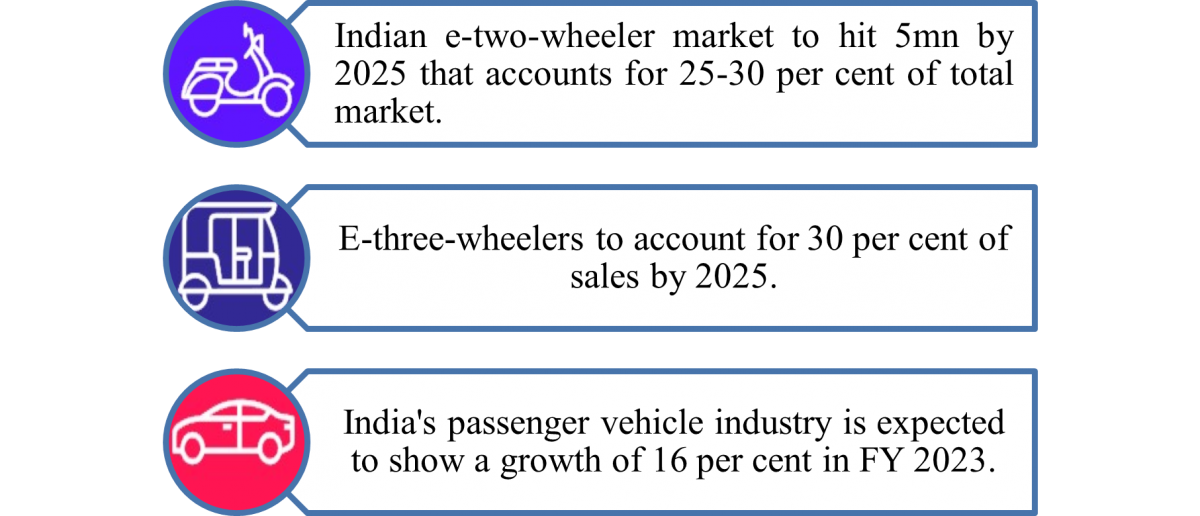
- By 2030, the EV market is anticipated to reach 10 Mn annual sales, growing at a Compound Annual Growth Rate (CAGR) of 49% between 2022 and 2030
- Between April 2000 and March 2022, the sector attracted equity inflows from Foreign Direct Investment (FDI) of $ 32.84 Bn, or 6% of all FDI in equities during that time.
Government initiatives and achievements in this sector
Following are a few steps taken to boost the growth of the EV sector in India.
Firstly, many conventional automotive players and oil companies are investing heavily to boost EV demand to reach the aspirational goal. To name a few, Skoda revealed its plan to produce EVs locally in India in 2021, and Indian Oil Corporation stated its plans to create 22,000 EV charging stations over three to five years.
Secondly, the Indian government has also been implementing several programmes to encourage the growth of electric mobility, including 100 per cent FDI through the automotive route in the EV space, incubator programmes, shared facilities for prototyping and small-scale manufacturing, financial support through the Credit Guarantee Scheme for Start-ups (CGSS), tax breaks, and subsidies for consumers.
Thirdly, in 2021, investment into EV startups reached a record high, rising by about 255 per cent to reach $ 444 Mn. For example, Ola Electric ($ 253 Mn), Blusmart ($ 25 Mn), Simple Energy ($ 21 Mn), Revolt ($ 20 Mn), and Detel ($ 20 Mn) were the EV firms that received the most financing in 2021. About 500 startups spanning the whole EV value chain make up the Indian EV ecosystem, with 63 per cent of those startups solely dedicated to manufacturing.
Fourthly, the Production linked incentive (PLI) scheme (with a $ 3.5 Bn budget) for the automotive industry suggests financial incentives of up to 18 per cent to encourage domestic production of high-tech automotive products and draw capital to the industry’s value chain. The PLI scheme promotes the domestic manufacture of EV batteries and less reliance on imports. This will considerably lower the cost of EVs and provide the necessary infrastructure to support the EV sector.
India has already achieved one of the benchmarks in the EV sector. The highway between Delhi and Chandigarh is the first in the nation to be made e-vehicle friendly by Bharat Heavy Electricals Limited (BHEL), successful commissioning 20 Solar Based EV Chargers. India’s total number of charging stations climbed by 285 per cent year over year in the financial year (FY) 2022; strong government measures are projected to accelerate the expansion to 4 lakh stations by FY 2026.
Why is the EV sector in India a good investment opportunity?
The EV industry’s importance and impending growth are already attracting investments in the sector. In 2021, it had around $6 Bn investments, which is expected to increase to $20 Bn by 2030.
The Automotive Mission Plan (AMP) 2016–26 encapsulates the goals shared by the Indian government and the automotive sector. According to the AMP 2016-26, the industry is expected to contribute more than 12% of the nation’s GDP, of which 7.1% has been achieved until now. It also aspires to constitute at least 40% of the manufacturing sector by the end of 2026. The automobile industry and India will change if these targets are met.
Another essential factor is that the nation’s internal lithium-ion battery production plans could lower EVs’ costs, reducing dependence and unsettling import duties. Hence, there will soon be a significant market in India.
India’s EVs are considered the key to the auto industry’s future. With the current climate change and worries about it, EVs are set to take over as the industry’s mainstay in the years to come.
Given that India’s EV business appears to have a bright future. By 2030, India’s focused efforts to promote shared, electric, and connected mobility may enable our country to reduce carbon dioxide emissions by one gigatonne.
Many private equity and venture capitalist investors have also invested in this sector, which grew from $181 Mn to $1.7 Bn. Several mutual funds like Mirae Asset Global Electric and Autonomous Vehicles exchange-traded fund (ETFs) Fund of Fund is an investment opportunity that invests in schemes like lithium and battery technology.
India’s auto industry has had significant growth and is expected to continue experiencing exponential expansion. In terms of how the market is doing, the pandemic has sparked a demand for goods that help reduce pollution levels, and EVs are a remarkable way to do so.
India launched the e-AMRIT portal in November 2021 as a one-stop destination for all EV-related information like charging location, investment opportunities, policies and subsidies in the sector.
Source: investindia.gov.in