Buying a two-wheeler, an e-rickshaw or freight vehicles is now going to allow a benefit of up to Rs 30,000 and for a four-wheeler, a benefit of up to 1.5 lakh which is the first of its kind in the country.
The Delhi government’s new Electric Vehicle (EV) Policy is intended towards improving the economy, decreasing the pollution crisis in and around the city, and most importantly boosting the sales and use of electronic vehicles. Few moves that are fitting at this hour are the commercial incentives that are proposed for all purchasers of EVs for the coming three years. Buying a two-wheeler, an e-rickshaw or freight vehicles is now going to allow a benefit of up to Rs 30,000 and for a four-wheeler, a benefit of up to 1.5 lakh which is the first of its kind in the country. The incentive of Rs. 30,000 per e-scooter is a huge step to ramp up the sales of two-wheeler electric vehicles in Delhi.
Further, to encourage the purchase of electric mobility, the government has permitted the sales of EVs in India without a battery which no other country has allowed so far. The step is taken with the objective of reducing the cost of electric vehicles, as the battery is the costliest part of any EV. An automobile that is verified and sold as a combined vehicle and the OEM is accountable for the assurance, charging or swapping of batteries after the EV is sold, needs to be included in the proposal. This accounts for a significant impact on the economy from both industry and customer perspectives.

Financial benefits of the policy
The policy mentions that purchase of EVs will be exempted from paying road tax and registration fees. Currently, road tax ranges from 4 percent to 10 percent of the expenditure of the vehicle, and the registration fee amounts to about Rs. 3,000. Additionally, a subsidy of Rs 5,000 per kWh of the battery capacity up to Rs 30,000 given on the acquisition of each electric vehicle points towards a satisfactory profit on part of the buyers. For the first 1,000 e-cars or electric four-wheelers, a subsidy of Rs 10,000 per kWh is allotted, which is capped at Rs 150,000 per vehicle.
Furthermore, for those who plan to buy EVs for commercial usages, loans are made available at very low-interest rates, and registration and road tax fees are being waived off, thereby encouraging people to invest in this sector. These financial incentives are valid for both battery swapping and fixed charging vehicles. Additionally, the cumulative sales of newly purchased cars in the capital is estimated to be around 25 percent, as compared to the current 0.2 percent, and touching the aim of 100 charging stations across the city in the next year along with the target of installing 200 charging stations in the next 4 years is a game-changer in India’s EV story. This will overcome the reluctance to buy EVs as on-road recharging has always been a challenge for consumers.
The gradual shift to EV
Presently Delhi has over 83,000 EVs out of a total of over 11 million automobiles registered in the city. And out of that 83,000 registered electric vehicles, more than 75,500 are e-rickshaws, about 900 personal electric cars, and approximately 3,700 e-two-wheelers running across the streets of Delhi. There are mainly two difficulties influencing in contrary to the increase of private EVs in Delhi- (a) the high price of cars, and (b) the deficiency of adequate charging infrastructure. Nonetheless, the government’s goal to register at least 500,000 EVs in Delhi by 2025 comes with great but well-regulated challenges, if plans mentioned in the policy are executed as proposed.
With this, even the supply chain for the whole bandwagon of EV will be transformed which is not only necessary to thrive but usher in the next era of improved logistics processes. The types of mechanisms, i.e. the logistics processes which are now active, the markets of origin and destination, and the tiered character of automotive supply chains will have to modify to a great extent to cope with the trend. For example, the supply chain and logistics providers will have to adapt to the geography of battery and electric component production locations, etc. The incorporation of the battery pack and related elements will generate a new system. The logistic processes will have to keep in mind the adaptation of electricity as a power source, think of safety and handling necessities of applied batteries to keep a check on the cost in logistics processes.
Progressive transformation in logistics
Even the delivery service needs to incorporate new-age mobility solutions, like customising vehicle architecture designed for the E-commerce sector from bigger delivery trucks to two-wheelers, IT platform intended to optimize routes and delivery points to decrease the delivery time from days to less than an hour, as well as modified data accumulation as an additional service to enhance the existing E-commerce’s transformation towards Q-commerce.
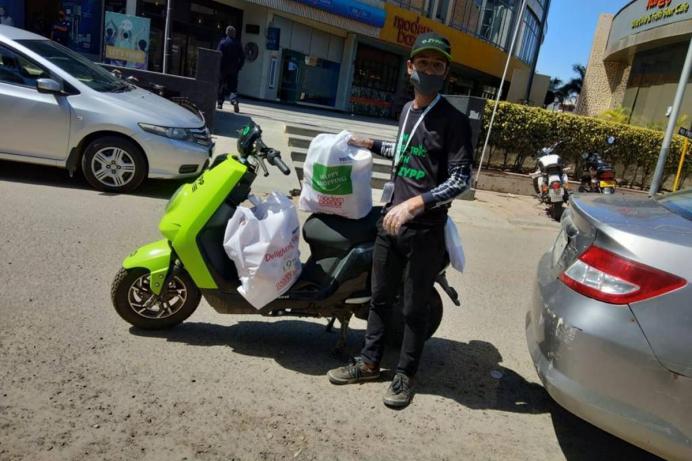
It is also estimated that the incentives ensured by the government will reassure delivery service providers, E-commerce logistics as well as courier facilities to shift to using electric two-wheelers EVs . Ascertaining the shift, delivery service providers are expected to convert 50 per cent of their fleet operating in Delhi to electric by March 31, 2023, and 100 per cent by March 31, 2025.
Finally with the launch of FAME II, if the EV sector has to grow, then the focus has to be on the high-speed vehicles offering the best alternative to ICE customers. Along with that, the electric two-wheeler market is also in demand for a huge transformation, as the current ratio, tilted in favour of low-speed scooters, is going to gradually change. Given that Indian customers are mostly price-conscious, even with the scale set to increase and battery prices set to fall, cheaper, low-speed models are likely to see the inflection point in the EV industry in FY 21-22.
Advantages of the scrappage incentive
Scrappage is one of the nightmares of buyers when it comes to the entire automobile sector. To make the switching to EVs smoother and faster, scrappage incentives are also included in the policy. These benefits are in addition to the subsidies provided by the Union government through the FAME II (Faster Adoption and Manufacturing of (Hybrid) and Electric Vehicles) scheme.
Apart from this, the new Delhi EV policy also has mentioned a scrappage policy that provides a purchase incentive when a customer scraps an old ICE (internal combustion engine) vehicle and buys a new EV, which is a unique approach towards addressing the scrapping problem of the entire automobile industry, making the purchase more affordable and reliable.
This well-timed resolution will enhance a swifter shift to clean mobility, thereby putting a check on the increasing air pollution in the city and adjacent areas. To make this project a success, manufacturers too will have to concentrate on decreasing the cost of four-wheelers in due time. Only through consumer-focussed incentivization can manufacturers very swiftly overcome the hurdle of bringing consumers to adopt electric vehicles.
The future of Indian mobility is electric
The blueprint of India’s EV story is holistic and is directed by a separate electronic vehicle department, the vision of seeing 50,000 EVs on the streets of the national capital is certainly achievable. Additionally, setting up a strong network of charging infrastructure including 200 charging stations will act as a catalyst to the development of the sector. It will successfully address the apprehensions of not just the electronic vehicle manufacturers, sellers, and customers, but will also boost business for other clean energy players to compete in the market.
However, the exclusion of other factors such as no limit for minimum vehicle range, no obligatory requirement of local manufacturing, and no condition for vehicles to have built-in suitable monitoring devices to determine the total fuel savings on a real-time basis has to be taken into consideration before the shift is finally made. Nevertheless, the overall policy will give a head-start and enable the EV led start-ups to save huge from the new policy and enjoy a higher adoption rate, and provide the much-needed push towards a 100 percent electric logistics by 2025.
Author: Akash Gupta, CEO and Co-Founder of ZYPP Electric Mobility
Disclaimer: The views and opinions expressed in this article are solely those of the original author. These views and opinions do not represent those of The Indian Express Group or its employees.