One of the marquee events at COP26 in Glasgow was Transport Day where the focus was on reducing emissions from transport – a sector that contributes to over a fifth of our CO2 emissions. A majority (~75%) of all transport emissions come from passenger and freight road transport and the emissions are rising faster than any other sector. At Cop26, a group of governments and automakers signed a declaration to accelerate the transition to zero emission vehicles globally by 2040.
India was also a signatory to this declaration but the entire narrative around clean transport was dominated by governments and automakers from developed markets primarily in Europe. Countries in Europe have a clear timeline to phase out sales of new Internal Combustion engine cars with countries like Norway looking to phase them out as early as 2025.
Over the past few years, electric vehicles seem to be at the heart of this transition to zero emission road transport. While most developed countries are already on their way towards this transition (again with Norway in the lead where > half of all new vehicles sold are electric), the question becomes whether there will be a “green” divide between the developed and developing world in EV adoption.
We had witnessed such a green divide in solar power where the developed world and China nearly monopolized its technology and manufacturing.
The possibility of this green divide in EVs is exacerbated by the fact that successful adoption of EVs needs to be supported by strong electrical infrastructure (i.e. strong grids that can support EV charging), easy access to finance and technology to bring the entire ecosystem around EVs together – components which are missing today in most emerging markets.
India for its part on the Cop26 Transport Day launched the e-Amrit portal where users can get access to information around electric vehicles and the know-how on the Indian EV ecosystem. While this may be symbolic in nature, India has the right ingredients needed to break the EV monopoly of the developed world and is today showing signs that it can become the torchbearer for electric mobility in emerging markets around the world.
India is the fifth largest automotive market in the world with a strong manufacturing base that manufactures ~25+ million vehicles a year. The manufacturing ecosystem is supported by a large, low-cost skilled labour pool and vibrant R&D/engineering centres.
The Indian automotive market and manufacturing is also dominated by the 2/3W segment.
Of the 20+ million 2/3Ws manufactured in India, we export ~4 million 2/3Ws every year mainly to other emerging markets around the world. Bajaj auto, Hero Motocorp and TVS are leaders in the 2/3W segments in large emerging markets of Africa, South East Asia and South America . Their success has largely been attributed to being able to replicate the high product and quality benchmarks demanded by the Indian consumer.
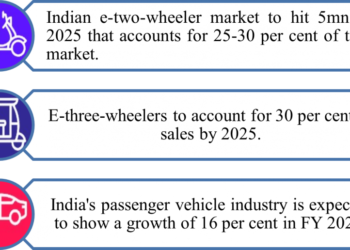
More recently, we have witnessed the sales of the electric versions of 2/3Ws in India have grown by over 200% y-o-y spurred by a combination of high fuel prices and favorable subsidies. OEMs and startups have taken notice with over 30 2/3W EV models available in the market today with many more to be launched in the next year. Just like with the traditional 2/3Ws, EV products that find a footing in the Indian market would likely succeed in other emerging markets and drive EV adoption.
Along with increased adoption of 2/3W EVs in the Indian market, we are also witnessing an increased presence of charging infrastructure in India to cater to this segment. Given the small size of battery packs and relatively lower power requirements to charge these vehicles, the charging infra story around 2/3W EVs is playing out in the form of battery swapping stations and smart sockets. Such solutions are easy to install, can be made ubiquitous and are unlikely to create too much strain on our electrical grid infrastructure. Large utilities and startups have entered this space to cater to the ever increasing charging demands of 2/3W EVs in India.
As with EV products, the charging infrastructure product and service templates being created for India can effectively be used to support EV adoption in emerging markets. Also, just like India, an additional benefit of creating this charging infrastructure for developing markets is that it allows for most of these countries to reduce their dependence on oil imports, eliminate fuel subsidies and move towards energy independence.
Decarbonization of road transport can play a significant role in helping move India towards our emission reduction targets (1 billion tonnes by 2030!) and becoming a net zero emitter by 2070. While the narrative around decarbonization and electrification of transport today is being built by the developed world, the Indian EV story can have a potential spillover effect in bridging the “green” divide between the haves and have nots of electric mobility.
Source: financialexpress.com