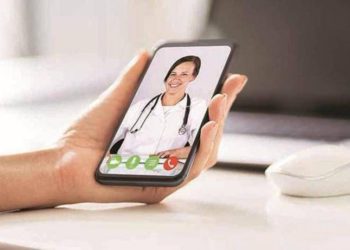
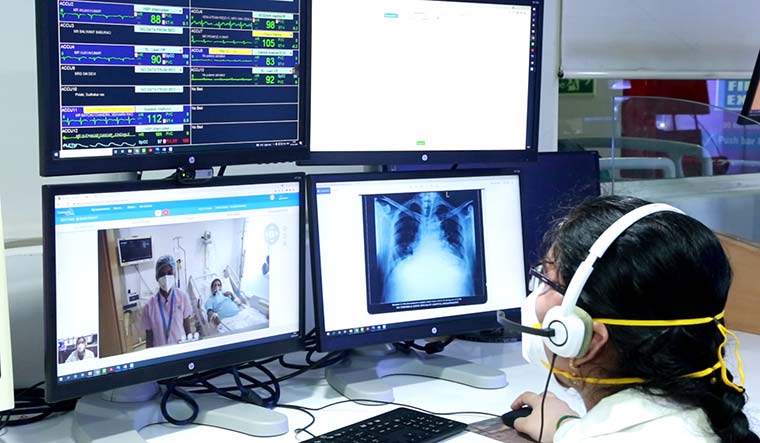
SOMETIME IN 2021, Dr Sai Praveen Haranath, a critical care expert, attended to a 40-year-old patient in Kolkata over a video call from the Apollo Hospitals tele-ICU command centre in Hyderabad. He had the patient’s data on the monitor in front of him. The Kolkata man was diagnosed with severe lung disease, and Haranath prescribed an emergency operation for him.The Apollo group has been in the telehealth domain for about two decades; it was, in fact, the first hospital to introduce teleconsultation in India.The eACCESS tele-ICU service of Apollo has provided consultations for more than 15,000 Covid-19 patients in the past two years.
The Apollo team immediately arranged an ambulance and shifted the patient to a hospital near his home. Haranath briefed the doctors at the local hospital, and soon the patient was admitted to the critical care unit.
In a similar case, a pneumonia patient who was admitted to a local hospital in Nalgonda, Telangana, was remotely monitored by an e-ICU team from Apollo. The patient had a history of hypertension, diabetes and coronary artery disease. Even after he was discharged from the local hospital, he was kept under health surveillance by the Apollo team. His family was provided with a monitor which was connected to the e-ICU. His vital parameters like heart rate, blood pressure and oxygen saturation levels were monitored continuously with a contactless interface.
Five days after being discharged, the patient developed sudden breathlessness and palpitations; the real-time monitor of the e-ICU showed a heart-rhythm disorder and a drop in oxygen saturation levels. The family and the local hospital were notified immediately by Apollo, and paramedics were sent to the patient’s home from the peripheral centre. The e-ICU doctor gave instructions to paramedics on the ground, and they succeeded in stabilising the patient.
At a time when Covid-19 has hampered mobility and put non-Covid critical care and other medical emergencies on the back-burner, technology is coming to the rescue of patients who otherwise had nowhere to go. Advanced audio-visual technologies, that combine data visualisation, predictive analytics and enhanced reporting capabilities, have enabled health care services to reach even the remotest location. The release of the telemedicine practice guidelines by the Union government during Covid has further enabled health care professionals to evaluate, diagnose and triage remotely.
Apollo Hospitals, with its emphasis on tech-enabled health care via Apollo Telehealth Services (ATHS), has been at the forefront of this medical revolution. The eACCESS tele-ICU service of Apollo has provided consultations for over 15,000 Covid-19 patients in the past two years. The group has been in the telehealth domain for about two decades; it was, in fact, the first hospital to introduce teleconsultation in India. Apollo is also the first hospital chain to start medicine delivery using drones.
“ATHS offers a comprehensive e-health solution, enabling quality health care delivery using the cloud network. It is the largest and oldest multi-speciality telemedicine network in South Asia,” says Dr K. Hariprasad, president, hospitals division, Apollo Hospitals. He points out that one of the major outcomes of the pandemic was its indirect impact on non-Covid chronic patients who had to suffer due to lack of hospital facilities, and unavailability of doctors.
“Teleconsultation harnesses the benefits of ICT (information and communication technology) and biomedical technology for bringing quality health care closer to underserved communities,” he says. “ATHS provides specialised solutions like tele-emergency, teleradiology, telecardiology, teleophthalmology, tele-consults and non-communicable diseases management. [It makes available] specialised and quality services from Apollo’s doctors to remotely located consumers.” Hariprasad notes that ATHS delivers more than 25,000 daily transactions through its command centre. “With the health care systems focusing on the pandemic, age-related issues like diabetes and cardiac management were worsening,” he says. “This led to the push for implementation of the Apollo 247 app, which brought the entire health setup to a person’s doorstep with virtual consultations, home-sample collection for diagnostics and home delivery of drugs and medication.”
Apollo also created a separate communication application to update the family on patient care. The app also allows families to raise queries or request video consultations. Telehealth, say experts, has come of age in India. And this is especially true for intensive care as continuous monitoring of vital physiology is key to effective care in critical cases.
As per a report published by Apollo in 2020 on tele-ICU networks, the country has a skewed distribution of critical-care doctors—most of them tend to be working in urban tertiary-care hospitals. So, remote health facilities without onsite intensivists benefit largely from tele intensive care services. There are also non-invasive ventilators that can be adjusted via the internet.
The All India Institute of Medical Sciences (AIIMS), too, has started a National e-ICU programme for Covid-19 management, supporting intensive care units from different parts of India. AIIMS has been mentoring and supporting 43 big hospitals in 11 states through virtual sessions. As Omicron cases are rising, tele-ICU networks, believes Hariprasad, are a viable option for India to manage critical-care needs arising from Covid-19 as well as other diseases.
Dr Preetha Reddy, executive vice-chairperson, Apollo Hospitals, says that overcharging patients or compromising on the quality of care are things that cannot and should not be tolerated during a pandemic. Reddy adds that the inefficiencies in hospital processes should be corrected with advanced technologies. “Using technology as much as we can is the way forward,” she says.
Source: theweek.in