
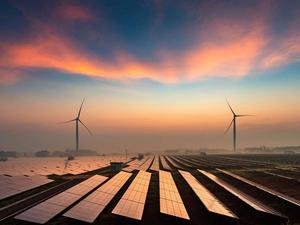
In recent months, India’s biggest private sector players have made ambitious clean energy commitments. Reliance NSE -0.48 % India Ltd announced clean technology investments worth Rs 75,000 crore; ArcelorMittal pledged Rs 19,000 crore for solar power; and Adani NSE -0.41 % Green raised Rs 9,570 crore in debt financing. Backed by India’s billionaires, these announcements herald a new chapter of clean energy expansion in our country. But why aren’t our energy public sector undertakings (PSUs) also at the forefront of India’s energy transition?
PSUs continue to play a vital role in India’s energy sector and the wider economy. Energy sector PSUs account for seven of India’s 10 Maharatnas — firms that have an annual turnover of more than Rs 25,000 crore. Over 50 per cent of the country’s power generation is publicly owned. Just two PSUs produce around 90 per cent of the country’s coal output.Publicly-owned oil marketing companies are responsible for 57 per cent of refining and almost all retail distribution. Since independence, these companies have been vehicles of nation-building, creating millions of jobs and generating revenue for the government. But as the world shifts away from fossil fuels, India’s energy majors, unfortunately, continue to invest in them.
A recent report by the International Institute for Sustainable Development (IISD) and the Council on Energy, Environment and Water (CEEW) estimated that the seven major energy-related Maharatnas invested in 183 projects with a total value of Rs 2.4 lakh crore between FY14 and FY20. However, their total investments in renewable energy (excluding large hydro) stood only at Rs 25,000 crore—ten times less than their fossil fuel investments.
Further, these seven PSUs had a combined capital expenditure (CAPEX) of INR 1.4 lakh crore in FY20 alone. While a breakdown of this CAPEX is not available, public announcements indicate that it goes largely toward expenses linked to coal mining, oil and gas exploration and refining, and thermal power generation.
Winds of change
Some PSUs have recognised the need to adapt and have begun to respond. The most notable example is NTPC Limited, which arguably has the best business case for diversification and has set a target of 60 GW of net renewable energy capacity by 2032. Likewise, GAIL has a greenhouse gas emission reduction target and Coal India Ltd is considering getting into solar wafer manufacturing. Green hydrogen, too, has seen interest from India’s oil marketing companies. For instance, the Indian Oil Corporation (IOCL) has announced plans to build the nation’s first green hydrogen plant at its Mathura refinery.
Still, PSUs are showing far less ambition than their private sector competitors and risk falling behind. If India is to meet its national energy transition and decarbonisation targets, PSUs must step in with big money commitments towards clean energy. There is also a business case for doing so.
First, energy PSUs should take advantage of their strong balance sheets, which enable them to raise capital at favourable rates. They should also keep in mind that global investment trends have started moving away from fossil-intensive projects. The U.K. has decided to stop financing overseas fossil fuel projects, and the U.S. is looking to follow suit. The world’s biggest fund manager, Blackrock, has announced plans to divest from fossil fuel assets and put sustainability at the core of its business model. These developments indicate that companies with fossil-intensive portfolios will increasingly struggle to access foreign capital.
Second, energy PSUs that fail to divest quickly enough are likely to be saddled with stranded fossil fuel assets, face rising capital costs, and suffer falling returns. They could also lose out on opportunities to attract lucrative Environmental, Social, and Governance investor funds, which are expected to reach a value of INR 350 lakh crore globally by 2025.
Third, energy PSUs have a mandate to deliver socially desirable outcomes, a requirement that distinguishes them from their peers in the private sector. From their inception and until recently, PSUs received priority access to natural resources in exchange for promising to improve the quality of life of Indian citizens. Their business decisions will continue to affect the lives of millions.
The central government has a key role to play in persuading PSUs to increase investments in clean energy. It has already instructed them to increase their capital expenditure to support India’s post-COVID-19 economic recovery. But it must also provide a clean energy mandate in line with national targets, with a focus on actively curbing dependence on fossil fuels and scaling up new technologies like green hydrogen, offshore wind, and non-fossil, clean cooking.
No state-owned enterprise from a developing economy has managed to successfully navigate the ongoing transition to a low-carbon future. But that should inspire rather than discourage India’s energy PSUs. They have the social capital, political access, and financial strength to become world leaders in energy transition.
Source: economictimes.indiatimes.com