
Current directory: /home3/bjinbymy/public_html/indianext/wp-content/mu-plugins Using AI To Predict Heart Episodes - AI Next
Indianext
No Result
View All Result
Subscribe
  • News
    • Project Watch
    • Policy
  • AI Next
  • People
    • Interviews
    • Profiles
  • Companies
  • Make In India
    • Solutions
    • State News
  • About Us
    • Editors Corner
    • Mission
    • Contact Us
    • Work Culture
  • Events
  • Guest post
  • News
    • Project Watch
    • Policy
  • AI Next
  • People
    • Interviews
    • Profiles
  • Companies
  • Make In India
    • Solutions
    • State News
  • About Us
    • Editors Corner
    • Mission
    • Contact Us
    • Work Culture
  • Events
  • Guest post
No Result
View All Result
Latest News on AI, Healthcare & Energy updates in India
No Result
View All Result
Home AI Next

Using AI To Predict Heart Episodes

May 27, 2022
AI

Hyderabad: Artificial Intelligence (AI), Machine Learning (ML), Deep Learning (DL), Algorithms, and large amounts of data sets are the present-day buzzwords that are being increasingly used in all walks of life to predict outcomes.

Worldwide, software researchers and technology leaders are virtually in a race to collaborate with super-specialty doctors to unlock the potential of AI and predict a relatively healthy individual’s health risk in the future.

The idea is to utilise the past data, which is available in the form of electronic medical records of patients, and teach the AI-based computer systems through algorithms, to analyse permutations and combinations, and forecast the risk of healthy individuals falling sick with ailments.

In the foreseeable future, a day might come when AI-based systems will be able to accurately predict the exact disease a healthy individual might face in the next decade. While a lot more research in this field is yet to be taken up, a ground-breaking AI-based cardiac risk predicting system has been developed by software professionals from Microsoft and senior cardiologists from Hyderabad.

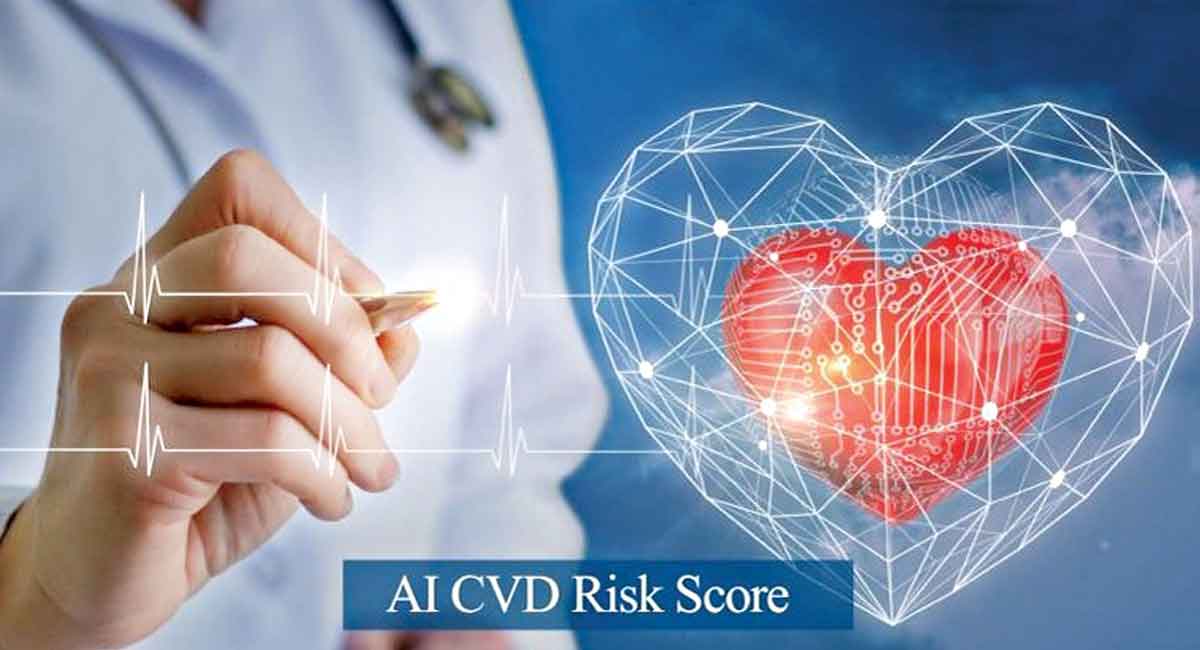
Yes, there is an AI-based computer system in Hyderabad that can, with a simple routine health check-up, predicts the risk of an individual from experiencing a heart episode, in the next 10 years. Dubbed as Cardiac Risk Score Calculation, the AI-based system is under implementation for the past 6 to 8 months across multiple facilities of Apollo Hospitals in Hyderabad and other major Indian cities.

“By utilising AI, Machine Learning, Deep Learning and Algorithms, we have developed a cardiac risk score, which tells the probability of getting a heart attack in the next ten years for individuals anybody between 18 years and 80 years. The accuracy of our AI-based cardiac risk score is between 89 per cent and 92 per cent,” says Head, Cardiology, Apollo Hospitals, Secunderabad, Dr J Shiv Kumar. It’s not easy for cutting-edge software developers from Microsoft Global and super-specialist cardiologists to come together, speak in a common language and develop an AI-based system.

“We are basically speciality doctors and Microsoft engineers were hardcore AI algorithm coders and technology thinkers. It took a year for both of us to understand each other’s thought processes and requirements. We started working together in 2017 and developed the AI risk score in 36-months,” says Dr Shiv Kumar.

The AI-based software, which is expected to get published in a globally recognised peer-review journal in the coming months, was also validated among 12,000 patients in the Netherlands.

So what started all this?

The Microsoft-powered Ai-based risk score is not the first cardiac risk score that is available. In fact, there is a globally-recognised Framingham Risk Score (FRS) risk assessment tool, which is widely recommended for coronary risk assessment.

However, there are some difficulties with such models. Existing risk assessment tools are regression models, which means they don’t leverage the potential of AI in assessing the risk of a patient. They take into account 6 to 12 risk factors while developing the risk score. Risk assessment tools developed by western countries are meant for local population and not for Indians.

“These risk scores were never tried in our local population and as a result, they always either underestimated or overestimated the risk. In Randomised Control Trials (RCTs), most of these existing models had an accuracy of 40 per cent to 45 per cent, which is the biggest flaw in such regression models,” Dr Shiv Kumar said.

Usually, to develop a risk score, group of super-specialist doctors come together and identify risk factors and recommend them, which are then used to develop the risk score.

“We did not want to select risk factors because there could be so many other relevant things that could be risk factors, which we are not aware of. That’s why, allowing AI-based systems to develop risk factors on its own was important,” he says.

Health data of 34,000 to 36,000 individuals, who underwent routine medical health check-ups at various branches of Apollo Hospitals in the country were utilised for the AI-based systems, which eventually identified 21 risk factors and based on that developed the cardiac risk score.

Source: telanganatoday.com

Leave a Reply Cancel reply

Your email address will not be published. Required fields are marked *

Editors Corner

How can Artificial Intelligence tools be a blessing for recruiters?

Will Artificial Intelligence ever match human intelligence?

Artificial Intelligence: Features of peer-to-peer networking

What not to share or ask on Chatgpt?

How can Machine Learning help in detecting and eliminating poverty?

How can Artificial Intelligence help in treating Autism?

Speech Recognition and its Wonders in your corporate life

Most groundbreaking Artificial Intelligence-based gadgets to vouch for in 2023

Recommended News

AI Next

Google: AI From All Perspectives

Alphabet subsidiary Google may have been slower than OpenAI to make its AI capabilities publicly available in the past, but...

by India Next
May 31, 2024
AI Next

US And UK Doctors Think Pfizer Is Setting The Standard For AI And Machine Learning In Drug Discovery

New research from Bryter, which involved over 200 doctors from the US and the UK, including neurologists, hematologists, and oncologists,...

by India Next
May 31, 2024
Solutions

An Agreement Is Signed By MEA, MeitY, And CSC To Offer E-Migration Services Via Shared Service Centers

Three government agencies joined forces to form a synergy in order to deliver eMigrate services through Common Services Centers (CSCs)...

by India Next
May 31, 2024
AI Next

PR Handbook For AI Startups: How To Avoid Traps And Succeed In A Crowded Field

The advent of artificial intelligence has significantly changed the landscape of entrepreneurship. The figures say it all. Global AI startups...

by India Next
May 31, 2024

Related Posts

Google
AI Next

Google: AI From All Perspectives

May 31, 2024
Pfizer
AI Next

US And UK Doctors Think Pfizer Is Setting The Standard For AI And Machine Learning In Drug Discovery

May 31, 2024
Artificial-Intelligence
AI Next

PR Handbook For AI Startups: How To Avoid Traps And Succeed In A Crowded Field

May 31, 2024
openai
AI Next

OpenAI Creates An AI Safety Committee Following Significant Departures

May 31, 2024
Load More
Next Post
TCS

TCS Partners With Deakin University To Co-Develop Corporate Learning Programme

IndiaNext Logo
IndiaNext Brings you latest news on artificial intelligence, Healthcare & Energy sector from all top sources in India and across the world.

Recent Posts

Google: AI From All Perspectives

US And UK Doctors Think Pfizer Is Setting The Standard For AI And Machine Learning In Drug Discovery

An Agreement Is Signed By MEA, MeitY, And CSC To Offer E-Migration Services Via Shared Service Centers

PR Handbook For AI Startups: How To Avoid Traps And Succeed In A Crowded Field

OpenAI Creates An AI Safety Committee Following Significant Departures

Tags

  • AI
  • EV
  • Mental WellBeing
  • Clean Energy
  • TeleMedicine
  • Healthcare
  • Electric Vehicles
  • Artificial Intelligence
  • Chatbots
  • Data Science
  • Electric Vehicles
  • Energy Storage
  • Machine Learning
  • Renewable Energy
  • Green Energy
  • Solar Energy
  • Solar Power

Follow us

  • Facebook
  • Linkedin
  • Twitter
© India Next. All Rights Reserved.     |     Privacy Policy      |      Web Design & Digital Marketing by Heeren Tanna
No Result
View All Result
  • About Us
  • Activate
  • Activity
  • Advisory Council
  • Archive
  • Career Page
  • Companies
  • Contact Us
  • cryptodemo
  • Energy next
  • Energy Next Archive
  • Home
  • Interviews
  • Make in India
  • Market
  • Members
  • Mission
  • News
  • News Update
  • People
  • Policy
  • Privacy Policy
  • Register
  • Reports
  • Subscription Page
  • Technology
  • Top 10
  • Videos
  • White Papers
  • Work Culture
  • Write For Us

Welcome Back!

Login to your account below

Forgotten Password?

Retrieve your password

Please enter your username or email address to reset your password.

Log In

Add New Playlist

IndiaNext Logo

Join Our Newsletter

Get daily access to news updates

no spam, we hate it more than you!