Telehealth is not new to India. ISRO started one of the first initiatives in 2001 by connecting remote rural medical college hospitals and mobile vans to major specialty hospitals in cities and towns using VSAT communication. However, the impact that telehealth solutions have had on the Indian healthcare system over the years has been low.
Telehealth has the potential to improve access to care, reduce healthcare costs, improve health outcomes for patients and improve the productivity of clinicians significantly. This is accomplished by leveraging technology to change the way that the various stakeholders in the healthcare ecosystem interact with each other and with machines, and by using technology to analyze the data generated from all these interactions.
The recent COVID19 pandemic has forced people to interact virtually, not just for healthcare related services but also when working from home, for education etc. This firsthand experience of interacting virtually, will continue to bring about a radical change in the way people perceive telehealth. This is reflected in the fact that platforms like WhatsApp, Zoom and various telehealth providers like Portea and Practo have seen a substantial increase in their business volumes in 2020.
To further accelerate the much-required adoption of telehealth in the country there are several enablers that need to be addressed with a sense of urgency. Some of these enablers are:
- Faster and reliable Communication infrastructure with high device connection density
- Training and accreditation required for practicing telemedicine
- Increased awareness on the benefits of telehealth
- Device Interoperability standards, Data Privacy and Regulatory policies
In 2020 NITI AAYOG released the “Guidelines for telemedicine practice” for virtual consultations. There is progress being made on the data privacy front too.
The deployment of Fifth Generation mobile communication technology (5G) can help address the communication needs of telehealth. 5G comes with a promise of high throughput (10 Gbps), low latency (<10ms), high reliability (99.99%) and high device connection density (~100 connections/unit area). These 5G attributes are significantly better when compared with existing 4G networks. This will help address some of the current gaps in 4G networks which are hindering the widespread adoption of advanced telehealth solutions in the country.
There are several highly impactful telehealth solutions (refer table above) that can be deployed across urban and rural India (This is not an exhaustive list).
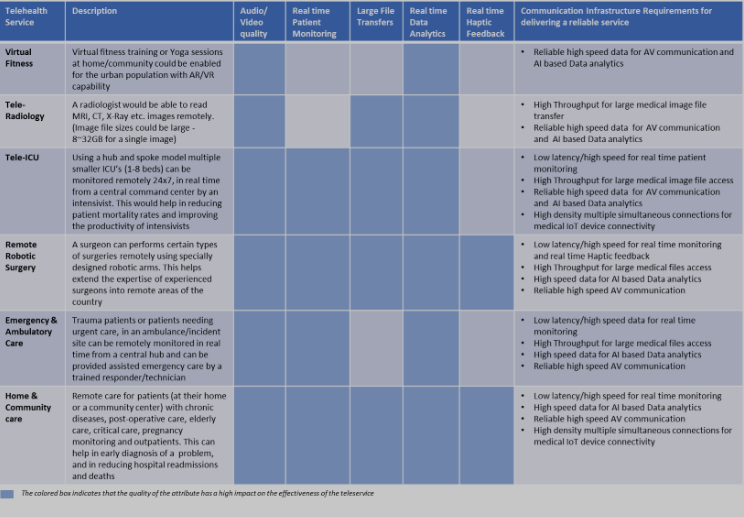
For each of these solutions to be impactful there is a need for a much-improved communication infrastructure that can support, reliable real time patient monitoring, transfer of large radiology image files with minimum delays, reliable audio and video communication, real time data analytics using AI, and real time haptic feedback when using remote robotic devices. 5G will address these needs given its high data speeds and throughput, low latency, high reliability and high device connection density.
- Higher data speeds and throughput are required to efficiently move large data files across the network with minimal delays and in real time data analytics.
- Low latency and high reliability will help in streaming real time patient monitoring data and in real time haptic feedback in robotics.
- Higher Device connection density will help support multiple simultaneous connection of IoT devices used for remotely monitoring patients and healthcare devices.
These solutions will increase the access to care for people living in even the remotest part of the country. The extent of impact on cost, quality, productivity and the government spend will depend on the solution deployed.
To understand this better, let’s take the example of a patient living in rural India who has undergone a cardiac procedure for the placement of a stent, in a city hospital (due to an acute shortage of experienced cardiac surgeons in smaller towns invariably people travel to cities for specialized treatments).
Post discharge from the hospital, the patient is normally required to meet the cardiologist for routine checkups, several times during the first few months. These checkups happen at a fixed point in time. Adverse health related events happening in between these visits could go unnoticed, resulting in complications and in the readmission of the patient which would entail further hospitalization costs.
There would also be additional cost of travel to the city, opportunity costs in lost wages of the individual and also the people who accompany the individual for the consultation visits. These costs could add up to 2000~4000 Rs per visit (excluding the consultation charges). However, if the hospital provides the patient a certified connected wearable device for a few months on rental, the patient can be continuously monitored remotely, from a central command center which is also equipped with artificial intelligence tools.
The periodic review with the cardiologist can be also done remotely from a health center (equipped appropriately) which is located close to the patient, by using a smart phone made available at the health center. 5G will ensure the real time monitoring, data analytics and audio/video communication needs required for this solution. The patient can travel for a face-to-face consultation with the cardiologist only if required.
This solution can help in timely intervention in the case of a problem, reduce hospital re-admissions, reduce travel costs and also help in freeing up the cardiologist’s time for treating other patients.
For telehealth to reap the maximum benefits from 5G there are several other challenges that need to be addressed. Some of them are mentioned below.
- The high cost of connected medical devices Inadequate insurance coverage of telehealth services
- New investments required to upgrade hospital legacy monitoring devices and IT systems
- Enforcement of data privacy laws and device interoperability standards
- Regulatory policies required to support telehealth India is behind other developed countries in the deployment of 5G.
The first 5G service in the country is planned to be launched in 2021. Telehealth, which addresses many of the healthcare challenges in the country, will benefit immensely from this, and other 5G deployments in the future. The coming years will see an increased adoption of new and highly impactful telehealth solutions in the country.
Source- CXO Today