
Current directory: /home3/bjinbymy/public_html/indianext/wp-content/mu-plugins Scientists Develop Efficient Artificial Synaptic Network That Mimics Human Brain - Solutions
Indianext
No Result
View All Result
Subscribe
  • News
    • Project Watch
    • Policy
  • AI Next
  • People
    • Interviews
    • Profiles
  • Companies
  • Make In India
    • Solutions
    • State News
  • About Us
    • Editors Corner
    • Mission
    • Contact Us
    • Work Culture
  • Events
  • Guest post
  • News
    • Project Watch
    • Policy
  • AI Next
  • People
    • Interviews
    • Profiles
  • Companies
  • Make In India
    • Solutions
    • State News
  • About Us
    • Editors Corner
    • Mission
    • Contact Us
    • Work Culture
  • Events
  • Guest post
No Result
View All Result
Latest News on AI, Healthcare & Energy updates in India
No Result
View All Result
Home Solutions

Scientists Develop Efficient Artificial Synaptic Network That Mimics Human Brain

June 1, 2021
Artificial Synaptic Network

New Delhi: Scientists have fabricated a device that can mimic human brain cognitive actions and is more efficient than conventional techniques in emulating artificial intelligence, thus enhancing the computational speed and power consumption efficiency.

Artificial intelligence is now a part of our daily lives, starting from email filters and smart replies in communication to helping battle the Covid-19 pandemic. But AI can do much more such as facilitate self-driving autonomous vehicles, augmented reality for healthcare, drug discovery, big data handling, real-time pattern/image recognition, solving real-world problems, and so on. These can be realised with the help of a neuromorphic device which can mimic the human brain synapse to bring about brain-inspired efficient computing ability. The human brain comprises of nearly a hundred billion neurons consisting of axons and dendrites. These neurons massively interconnect with each other via axons and dendrites, forming colossal junctions called synapse. This complex bio-neural network is believed to give rise to superior cognitive abilities.

Software-based artificial neural networks (ANN) can be seen defeating humans in games (AlphaGo and AlphaZero) or helping handle the Covid-19 situation. However, the power-hungry (in megawatts) von Neumann computer architecture slows down ANNs performance due to the available serial processing while the brain does the job via parallel processing consuming just 20 W. It is estimated that the brain consumes 20% of the total body energy. From the calory conversion (https://hypertextbook.com/facts/2001/JacquelineLing.shtml), it amounts to 20 watts. While the conventional computing platforms consume megawatts, i.e., 10 lakh watts of energy, to mimic basic human cognition.

To overcome this bottleneck, a hardware-based solution involves an artificial synaptic device that, unlike transistors, could emulate the functions of human brain synapse. Scientists had long been trying to develop a synaptic device that can mimic complex psychological behaviors without the aid of external supporting (CMOS) circuits.

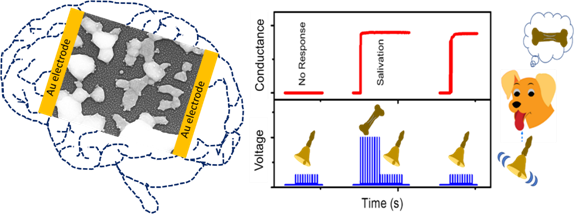
To address this challenge, Scientists from Jawaharlal Nehru Centre for Advanced Scientific Research, Bengaluru, an autonomous institute of the Department of Science & Technology, Government of India, devised a novel approach of fabricating an artificial synaptic network (ASN) resembling the biological neural network via a simple self-forming method (the device structure is formed by itself while heating). This work has been recently published in the journal ‘Materials Horizons’.

Aiming to develop a synaptic device for neuromorphic applications with a humble fabrication method, the JNCASR team explored a material system mimicking neuronal bodies and axonal network connectivity much like the biological system. In order to realize such a structure, they found that a self-forming process was easy, scalable, and cost-effective.

In their research JNCASR team dewetted Silver (Ag) metal to form branched islands and nanoparticles with nanogap separations to resemble bio neurons and neurotransmitters where dewetting is a process of rupture of continuous film into disconnected/isolated islands or spherical particles. With such an architecture, several higher-order cognitive activities are emulated. The fabricated artificial synaptic network (ASN) consisted of Silver (Ag) agglomerates network separated by nanogaps filled with isolated nanoparticles. They found that dewetting Ag film at a higher temperature resulted in the formation of island structures separated by nanogaps resembling the bio-neural network.

Using programmed electrical signals as a real-world stimulus, this hierarchical structure emulated various learning activities such as short-term memory (STM), long-term memory (LTM), potentiation, depression, associative learning, interest-based learning, supervision, etc. impression of supervision. Synaptic fatigue due to excessive learning and its self-recovery was also mimicked. Remarkably, all these behaviors were emulated in a single material system without the aid of external CMOS circuits. A prototype kit has been developed to emulate Pavlov’s dog behavior which demonstrates the potential of this device towards neuromorphic artificial intelligence. By organizing a nanomaterial resembling the biological neural substance, the JNCASR team has moved a step further in accomplishing advanced neuromorphic artificial intelligence.

“Nature has had an incredible amount of time and diversity to engineer ever new forms and functions through evolution. Learning and emulating new processes, technologies, materials and devices from the nature and biology are the important pathways to the significant advances of the future which will increasingly integrate the worlds of the living with the man-made technologies,” said Prof Ashutosh Sharma, Secretary, DST.

Source: indiaeducationdiary.in

Leave a Reply Cancel reply

Your email address will not be published. Required fields are marked *

Editors Corner

How can Artificial Intelligence tools be a blessing for recruiters?

Will Artificial Intelligence ever match human intelligence?

Artificial Intelligence: Features of peer-to-peer networking

What not to share or ask on Chatgpt?

How can Machine Learning help in detecting and eliminating poverty?

How can Artificial Intelligence help in treating Autism?

Speech Recognition and its Wonders in your corporate life

Most groundbreaking Artificial Intelligence-based gadgets to vouch for in 2023

Recommended News

AI Next

Google: AI From All Perspectives

Alphabet subsidiary Google may have been slower than OpenAI to make its AI capabilities publicly available in the past, but...

by India Next
May 31, 2024
AI Next

US And UK Doctors Think Pfizer Is Setting The Standard For AI And Machine Learning In Drug Discovery

New research from Bryter, which involved over 200 doctors from the US and the UK, including neurologists, hematologists, and oncologists,...

by India Next
May 31, 2024
Solutions

An Agreement Is Signed By MEA, MeitY, And CSC To Offer E-Migration Services Via Shared Service Centers

Three government agencies joined forces to form a synergy in order to deliver eMigrate services through Common Services Centers (CSCs)...

by India Next
May 31, 2024
AI Next

PR Handbook For AI Startups: How To Avoid Traps And Succeed In A Crowded Field

The advent of artificial intelligence has significantly changed the landscape of entrepreneurship. The figures say it all. Global AI startups...

by India Next
May 31, 2024

Related Posts

MeitY
Solutions

An Agreement Is Signed By MEA, MeitY, And CSC To Offer E-Migration Services Via Shared Service Centers

May 31, 2024
Android
Solutions

Android Devices With Faster And More Intelligent Performance Than IPhones

May 18, 2024
Google
Solutions

Google Unveils AI Capable Of Predicting The Behavior Of Human Molecules, Accelerating The Search For New Drugs

May 17, 2024
MeitY
Solutions

Introduction Of Thermal Camera Technology And Product Booklet For Intelligent Transportation Systems (ITS) To Industry

May 3, 2024
Load More
Next Post
Narrowband IoT

Narrowband Iot Ignites Digital Transformation In India

IndiaNext Logo
IndiaNext Brings you latest news on artificial intelligence, Healthcare & Energy sector from all top sources in India and across the world.

Recent Posts

Google: AI From All Perspectives

US And UK Doctors Think Pfizer Is Setting The Standard For AI And Machine Learning In Drug Discovery

An Agreement Is Signed By MEA, MeitY, And CSC To Offer E-Migration Services Via Shared Service Centers

PR Handbook For AI Startups: How To Avoid Traps And Succeed In A Crowded Field

OpenAI Creates An AI Safety Committee Following Significant Departures

Tags

  • AI
  • EV
  • Mental WellBeing
  • Clean Energy
  • TeleMedicine
  • Healthcare
  • Electric Vehicles
  • Artificial Intelligence
  • Chatbots
  • Data Science
  • Electric Vehicles
  • Energy Storage
  • Machine Learning
  • Renewable Energy
  • Green Energy
  • Solar Energy
  • Solar Power

Follow us

  • Facebook
  • Linkedin
  • Twitter
© India Next. All Rights Reserved.     |     Privacy Policy      |      Web Design & Digital Marketing by Heeren Tanna
No Result
View All Result
  • About Us
  • Activate
  • Activity
  • Advisory Council
  • Archive
  • Career Page
  • Companies
  • Contact Us
  • cryptodemo
  • Energy next
  • Energy Next Archive
  • Home
  • Interviews
  • Make in India
  • Market
  • Members
  • Mission
  • News
  • News Update
  • People
  • Policy
  • Privacy Policy
  • Register
  • Reports
  • Subscription Page
  • Technology
  • Top 10
  • Videos
  • White Papers
  • Work Culture
  • Write For Us

Welcome Back!

Login to your account below

Forgotten Password?

Retrieve your password

Please enter your username or email address to reset your password.

Log In

Add New Playlist

IndiaNext Logo

Join Our Newsletter

Get daily access to news updates

no spam, we hate it more than you!