
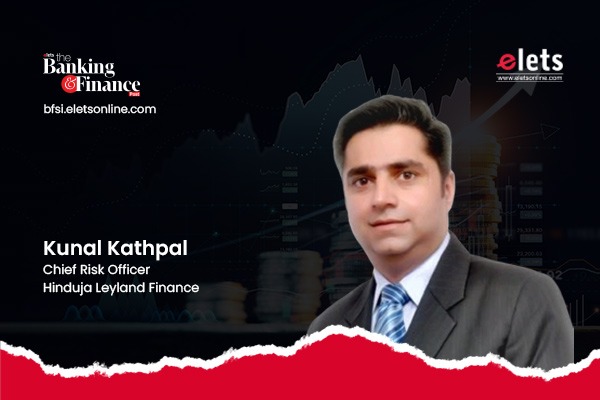
In the last two years Hinduja Leyland Finance has been focusing on business beyond our traditional new vehicle financing business and we are now trying to tap the other life cycle of a vehicle which is the operating life cycle and the resale market of a vehicle. To know more about phygital model of NBFCs, Shruti Jain of Elets News Network (ENN), interacted with Kunal Kathpal, Chief Risk Officer, Hinduja Leyland Finance.
Q. How is AI & ML helping in the continuous evaluation of the underwriting & risk model for the NBFCs?
Ans. NBFCs in India are required to do KYC and credit assessment as part of the credit underwriting process. Traditionally these were done based on documents that were provided by the applicants and then a credit underwriter used to do a manual interpretation of the same based on the credit policy. This method had challenges like scalability, assessment errors, costly and standardisation etc. To make this process more efficient NBFCs start introducing automated underwriting modules where policy parameters were coded and inputs were entered by humans. This model also had its own share of limitations like input errors, outputs were having more referrals than decisions.
However, over the period of time NBFC have learnt this art of lending and converted it into science giving them the agility to adopt AI and ML for this customer segment.
With the digital footprint increasing in the new age NBFCs in India are leveraging Artificial Intelligence (AI) and Machine Learning (ML) solutions to automate
their key business processes like customer onboarding, decision making, risk management, etc.
According to a recent study of FICCI and PWC – 83 per cent of Indian financial organisations say AI helps to enhance customer experience.
These models are prepared in such a way that they are improvised on the basis of the historical data and current trends. Credit model management teams continuously review the adjustments in the models in line with the corelated macroeconomic indicators. The performance of these models is compared to the risk appetite of the organisation. Hence making it a continuous evaluation process.
Q. As the emerging technologies disrupt the NBFCs, what risks is your organisation facing to on-board traditional customers during the journey?
Ans. As India has embarked on the journey to increase its digital footprint and increase the banking population by spreading its banking network to Tier 3, 4 cities and rural sector. There are still customers who are new-to-credit with a low digital footprint hence there is still dependence on manual onboarding of such customers.
During the onboarding of these customers due to the limited digital footprint and lack of data in some areas, there are challenges that credit underwriters have to encounter such as –
Subjective parameters – there is still a heavy reliance on documentation for some of the parameters in the scorecards which are filled by personal judgement.
Human Interpretation – lack of authentic data source which can help in assessing the viability assessment and cashflows of the borrower human intervention is required to interpret the data.
Scalability and time to take decision – Given the huge dependence on human judgement-based decision-making process, it will always pose challenges of scalability and will be time consuming effort as each decision-making parameter has to be manually validated.
However, as the digital foot print is growing the traditional models are also moving towards “Phygital – combination of digital and physical” models of underwriting.
Q. How is RPA getting used in the section of risk management? How is it preventing fraud?
Ans. Robotic Process Automation is an automated technology that enables to record actions performed by humans on a computer, and then this process can be done without humans.
There are four broad ways in which RPA helps in reducing overall risks:
1. Minimise human judgement – An RPA robot performs tasks without any human shortcomings such as biases, variations, errors or fatigue.
2. Simplification of Credit Assessment – When applying RPA in the loan origination system, the processes like KYC verification, conversion and validation becomes more simplified thus streamlining the overall credit assessment of applicants.
3. Compliance Factor – An RPA will be different for different product types.
So, any change specific to any product is updated in the RPA system, thereby reducing the time to recreate sperate systems for sperate products.
4. Standardise the process – An updated version of RPA can assure that your company would be able to keep abreast of all the necessary requirements. The correct RPA automation tool would be agile and would mitigate risks by enabling the systems to make room for any new change to occur and deal with complexity.
RPA prevents frauds in the following ways-
1. Reassessing current processes
Financial organisations can program RPA bots to review current and historical financial transactions to find anomalies and a typical patterns that can indicate illegal or fraudulent activities. RPA will require the financial institution to study, document, assess the current processes, leading to deeper insights and identifying high-risk areas.
2. Identifying vulnerabilities – RPA bots can be automated to review current transactions and compare it with historical transactions to assess a pattern on a timely basis which helps to identify uneven patterns that may expose anomality which could be illegal or fraudulent activities.
3. Speeding fraud investigations –RPA gathers data from multiple sources and then analysis it in a faster manner, allowing investigators to spend more time resolving fraud cases.
Q. How is Hinduja Leyland diversifying risk across sectors?
Ans. Hinduja Leyland Finance has been diversifying its portfolio into various categories such as commercial vehicle finance, construction equipment finance, personal vehicle finance, loan against property and affordable housing finance.
All these products have their own set of customers and markets with difference behavioural patterns, allowing us to design our products based on different risk appetite for each of them.
What are your plans for the year 2023?
Ans. As a company we are on a continuous journey to achieve our mission i.e. “to be among the most preferred financial services providers in India for all our stakeholders (customers, partners, employees, shareholders)”
In the last 2 years HLF has been focusing on business beyond our traditional new vehicle financing business and we are now trying to tap the other life cycle of a vehicle which is the operating Life cycle and the resale market of a vehicle. For this we have launched platforms like GRO digital in partnership with Ashok Leyland wherein GRO will handle (and in the process facilitate) various operational aspects of the Vehicle Operating Life Cycle (like load matching, fleet solution, fastTag, fuel recharge etc.) and HLF will offer credit products around this like bill discounting, tyre credit, fuel credit etc.
Also, HLF through its subsidiary Gaadi Mandi has created an online platform for sale/purchase of used vehicles. This has helped in higher realisation on resale of vehicles repossessed by HLF and other financers (with whom we plan to tie up) by removing intermediaries.
These initiatives, though, are in their nascent stage as of now will help us grow faster by mitigating risk (helping the customer increase his revenue through GRO platform and Ring Fence cashflows, as the cashflow and payments will pass through those specific platforms/systems) and improved realisation and cost savings through Gaadi Mandi.
Hence, we will continue our journey toward achieving our mission statement by making more and more processes digitised as the data foot print of our customers increase and create an ecosystem of ease of doing business by supporting the customer throughout his lifecycle.
Source: bfsi.eletsonline.com