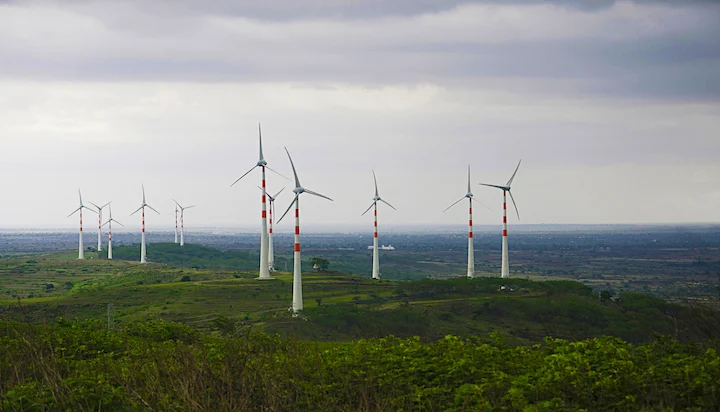
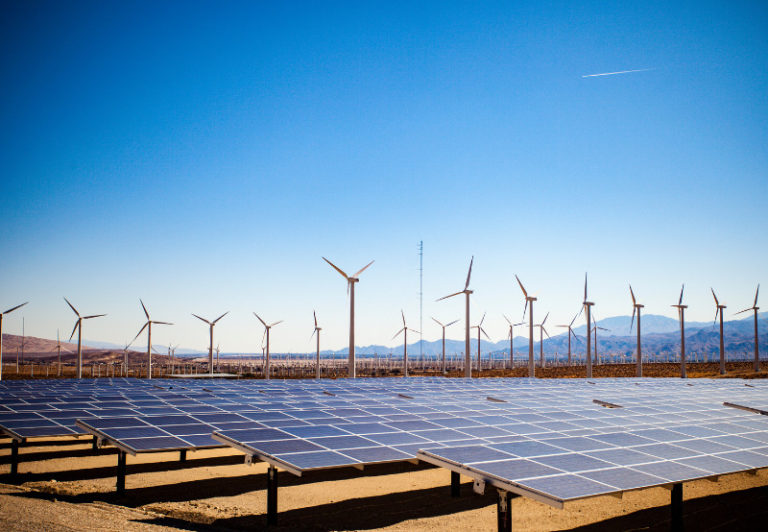
Much before the sun started shining on India’s solar power sector, the wind power industry was leading the country’s renewable energy domain. But over the last few years, with the limelight shifting to solar and lack of regulatory support, India’s wind power industry is gasping for air.
In fact, the wind power sector is an important component in India’s plans to decarbonise its energy sector. Wind power accounts for 60 gigawatts (GW) of the 175 GW target of installed renewable capacity by 2022 and 140 GW of the 450 GW target by 2030.
However, according to official data, India is behind on its annual wind energy installation target since 2017-18. Currently, India’s installed wind power capacity is 39.48 GW capacity, the fourth-highest wind installed capacity in the world. But there is uncertainty over whether the government can achieve its target of 60 GW by 2022, which currently seems difficult.
One of the reasons, according to the Union Ministry of New and Renewable Energy (MNRE), for the slowing down of the installation of the wind power projects, is the shift to a bidding route that seeks the lowest per-unit price during an auction.
The MNRE explained in a recent parliament panel report that “the capacity additions till 2017 were through Feed-in Tariff (FiT) mechanism” but the subsequent shift to the tariff regime “slightly slowed the installation of projects.” It said that “presently the wind power projects in the country are installed on the basis of commercial viability through tariff-based competitive bidding process.”
“In order to provide sufficient capacity to the developers, regular bids for wind energy projects are being issued. The status of bids and implementation of projects is being monitored regularly,” it said.
Secretary-General of the Indian Wind Turbine Manufacturers Association (IWTMA), D.V. Giri told Mongabay-India, “Wind (energy sector) is very mature compared to solar” and thus it is “natural that government has been pushing solar”.
He, however, highlighted that unlike other sectors (such as solar power), which are heavily dependent on China (for import of components), the wind energy sector empowers local manufacturing of components. “Wind subscribes to the Make in India programme with 80 percent localisation providing rural employment and involvement of over 4,000 vendors and from the MSME (Micro, Small and Medium Enterprises) sector,” he said.
“Prior to 2017 when Feed-in Tariff (FiT) was operational, there was all-inclusive development and installation in all wind states, which facilitates investment, revenue for state governments, employment and a boost to the rural economy. After competitive bidding was introduced, tariff alone took centrestage and business got restricted to two high wind states of Gujarat and Tamil Nadu. The size of the bid was small which made the bidders quote aggressively and perhaps made the tariff almost unlikable,” Giri explained to Mongabay-India.
However, the March 2021 parliament panel report “Action Plan for achievement of 175 GW Renewable Energy target” notes that “tariff-based competitive bidding process has reduced the tariff of wind power considerably, from over Rs. four per unit through FiT to around Rs. 2.80 per unit in bidding regime.” The panel had recommended the ministry to have consultations with all the stakeholders about the shift in tariff regime so that achievement of the overall target of 60 GW by 2022 does not get hampered.
Giri said that India has a “manufacturing capacity of 10 GW (per year) chasing a market of 1.5 GW in the last four years.”
“Since the central bid minimum size is 50 MW, it denied the opportunity for small and medium investors. Government has a laudable target of 140 GW by 2030 which translates to 11 GW per annum for the next 10 years. This volume cannot be filled by bidding route with fiscally stressed discoms (power distribution companies),” he said.
Meanwhile, K. Kasthurirangaian, who is the Chairman of the Indian Wind Power Association (IWPA), said the wind power sector is receiving good support from the central government but not from the state governments. He said that one of the major reasons plaguing the growth of the wind power sector is the “lack of any financial incentive.”
“The prices of both wind and solar power have come down due to reverse bidding. The problem is that the state discoms (power distribution companies) are reluctant to pay,” he told Mongabay-India.
Finding land for wind power projects is another concern
Another major reason that the experts and developers highlight behind the slow growth of the wind power sector is the difficulty in securing the land for the projects – something that has been hampering the growth of the solar sector as well.
Vibhuti Garg, an energy economist with the Institute of Energy Economics and Financial Analysis (IEEFA), said lack of land resources is one of the main factors that are impacting the growth of the wind power sector in India.
“The land is a huge constraint in the development of renewable power. Another major issue is that most of the good wind sites have been already taken over in India even as the current projects at those places have a low power generation capacity. In such a scenario, where developers already have the PPAs (power purchase agreements), they are not interested in investing more money in newer technologies that can help increase generation on those good wind sites,” Garg explained to Mongabay-India.
She said that what is required is the repowering of wind power assets to improve their efficiency. “Moreover, the government benefits that the wind sector had earlier are no more being offered to them. Thus, developers believe solar power is a much safer option than taking risks with wind power,” she said.
IWPA’s Kasthurirangaian also echoed similar sentiments as he said that the problem that “developers face in land allocation for wind projects is another major issue” and alleged that state governments are not cooperating in that.
Is off-shore wind power the answer?
The March 2021 parliamentary panel report had noted India is in the initial phase of offshore wind energy development and exhaustive offshore wind and other oceanographic surveys are underway to understand the nature of subsurface, seabed topology etc.
It observed that approximately 36 GW and 31 GW offshore wind power potential exist off the coast of Gujarat and Tamil Nadu. It said that as India has a long coastline of more than 7,500 kilometres, the MNRE should “extensively explore the offshore wind power potential in all other coastal States in a time-bound manner”, besides Gujarat and Tamil Nadu.
But Garg said, “As far as offshore wind power is concerned it is yet to become financially viable” and emphasised that “for wind, we are yet to see the kind of momentum that we saw for solar because of the high level of risk.”
According to the MNRE, the exact cost of the offshore turbine and tariff cannot be ascertained at this stage, since the “determination of per Megawatt cost of the offshore turbine and tariff of offshore wind projects depends on various factors” such as offshore vessels for wind power projects, wind characteristics, and environmental constraints.
However, the ministry explains that based on the preliminary studies, it is estimated that the per megawatt cost of the offshore wind turbine would be “two to three times the cost of onshore wind turbines.”
“With strong onshore wind turbine manufacturing base in India, the price of the offshore wind turbines and the tariff are expected to be competitive and at par with onshore wind turbine rates, at the time of large commercial-scale deployment of offshore wind turbines in the country,” stressed India’s renewable energy ministry.
How can the wind power sector regain momentum?
A June 2021 report, “India Wind Energy Market Outlook 2025” by the Global Wind Energy Council (GWEC) and MEC Intelligence (MEC+), a strategic advisory and market consulting firm, notes that India is expected to install nearly 20.2 GW of wind power capacity between 2021-2025, a growth of nearly 50 percent compared to the 39.2 GW currently installed in the country.
It states that the wind power sector “will be a critical link in India’s clean energy transition and green recovery”. It claimed that the impact of COVID-19 lockdowns on India’s wind power market was more severe than anticipated, with only 1.1 GW installed out of the 3.3 GW originally forecasted for 2020, but the market is set to bounce back.
“Over the next five years, 90 percent of new installed wind capacity will come from central tenders, followed by corporate procurements and state markets. New opportunities like repowering, hybrid projects, offshore wind, and corporate PPAs can help scale up India’s wind power capacity and deliver affordable, clean energy across the country,” said the report while calling for greater coordination between central and state governments around wind targets.
Kasthurirangaian of the IWPA also states that to ensure that the wind power sector continues to witness growth, the central government would “need to explore the possibility of incentives … because unless that happens the private sector money won’t flow.”
“In absence of any such incentives, the private sector is not keen on putting its money in the renewable energy sector. They should announce policy measures to attract the private investors,” he said.
D.V. Giri of the IWTMA, said the solutions for the stressed (wind power) sector include national tariff for all wind projects below 50 MW, state procurement by a determined tariff through state regulatory commission, investor-friendly repowering policy as land is a finite source and maximising of output with MW size turbine.
Source: moneycontrol.com