Current directory: /home3/bjinbymy/public_html/indianext/wp-content/mu-plugins Indian museum brings artist M F Husain back from the dead using AI
Indianext
No Result
View All Result
Subscribe
  • News
    • Project Watch
    • Policy
  • AI Next
  • People
    • Interviews
    • Profiles
  • Companies
  • Make In India
    • Solutions
    • State News
  • About Us
    • Editors Corner
    • Mission
    • Contact Us
    • Work Culture
  • Events
  • Guest post
  • News
    • Project Watch
    • Policy
  • AI Next
  • People
    • Interviews
    • Profiles
  • Companies
  • Make In India
    • Solutions
    • State News
  • About Us
    • Editors Corner
    • Mission
    • Contact Us
    • Work Culture
  • Events
  • Guest post
No Result
View All Result
Latest News on AI, Healthcare & Energy updates in India
No Result
View All Result
Home AI Next

Indian museum brings artist M F Husain back from the dead using AI

May 3, 2021
Indian museum brings artist M F Husain back from the dead using AI

Indian museum brings artist M F Husain back from the dead using AI

What would you say if you could speak to your favourite dead artist? Why did you choose that shade of blue? Did you really have to cut off your earlobe? Now fans of one of India’s most prominent artists M F Husain, who died in 2011, need wonder no more after a museum has brought him back to life (well, sort of).

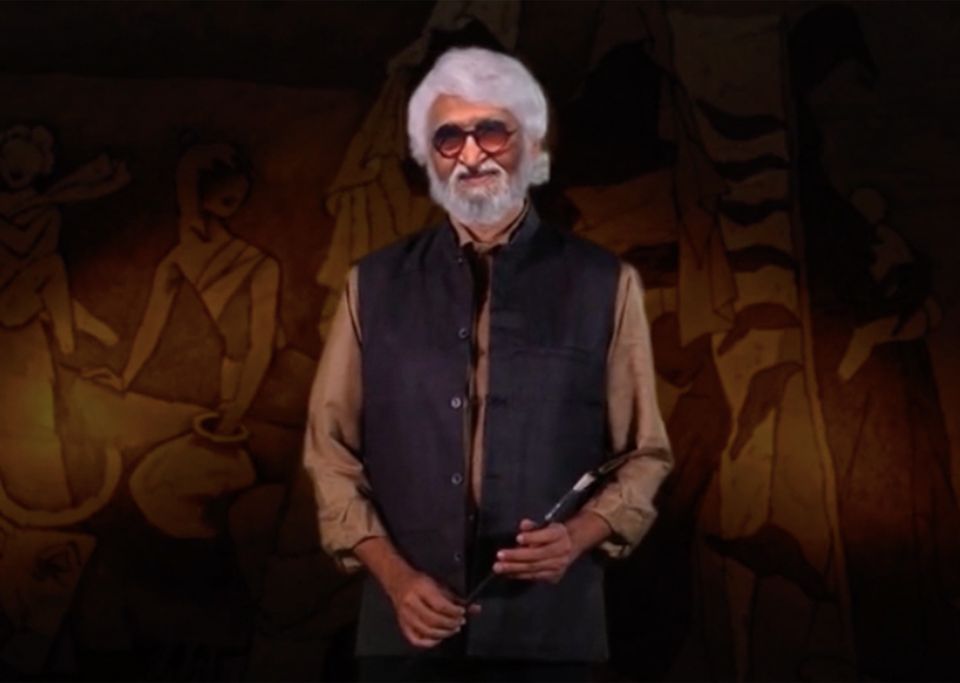
The Museum of Art and Photography in Bangalore (MAP), south India’s first major private art museum, has used artificial intelligence software to create a “conversational digital persona” of the Bombay Progressive painter. Technologies such as facial recognition, speech synthesis and language processing based on deep learning networks allow a three-dimensional hologram of Husain to respond to questions in real time.

Created in partnership with Accenture Labs, the research and development arm of the global consulting firm Accenture, Husain’s “digital twin” can discuss topics relating to his life and work and is even capable of quippy comebacks. When asked by a visitor in a promotional video why his voice sounded strange, the hologram responded that he was “nearly 100 years old after all”.

This virtual seance is one of many digital ventures that MAP, which is located in the “Silicon Valley of India”, has organised ahead of its physical opening. After plans to launch its 42,000-sq. ft space were derailed by the pandemic, the museum instead decided to go ahead with a digital opening in November that consisted of a six-day programme of guided collection tours, live-streamed performances and talks featuring notable South Asian cultural figures including the artist Jitish Kallat and the art historian B N Goswamy.

Touted by its founder-trustee Abhishek Poddar as a “museum of the future”, MAP will devote a sizeable portion of its programme to the confluence of art and technology, including a 40-ft interactive, multi-touch MicroTile wall that displays all the museum’s works on view in real time, holographic tables that display 3D version of works and virtual treasure hunts through the collection.

Technological innovation on this scale is virtually unheard of within India’s museum landscape, which is largely defined by low levels of visitor engagement or outreach and antiquated programming.

“MAP looks to redefine what an Indian museum can be,” Poddar says. “We have a 1,000-odd government museums but generally speaking, apart from some shining examples, they are subpar. A country like India could do with so much more. We need to excite and engage with people if they are going to step through our doors and technology is a major part of that.”

Poddar has donated the bulk of his collection to form most of the MAP’s 18,000 works of art and artefacts that tell the story of Indian culture stretching from the 12th century to today. It contains sections on photography, folk art, textiles and design as well as contemporary and 20th-century art, including works by major South Asian Modernists such as Tyeb Mehta.

Initial capital for the museum came from the sale of some of Poddar and his wife’s collection, which was auctioned for around £3.4m Christie’s India in 2016, before raising funds from private investors including the Tata Trust and the billionaire biopharmaceutical entrepreneur Kiran Mazumdar-Shaw. Poddar says he was adamant to not seek government help to ensure the museum could be as agile and flexible as possible. He hopes MAP’s cutting-edge ideas will create a knock-on effect on other museums in the country and help revitalise a sluggish sector. “What can one little museum do? We can provide a catalyst. India’s airports are unrecognisable to what they were a decade ago, all because a few renovated and the rest needed to pull up their socks,” Poddar says.

MAP has a particular focus on street art and, according to its artistic director Kamini Sawhney, it is one of the only museums in India with popular culture as a central part of the collection. She adds that the museum’s programme will also feature Indian classical dance and performance. “Collapsing the hierarchies between art forms is key to ensuring we are an expansive institution that addresses all avenues of creativity,” Sawhney says.

The museum hopes to open its doors later this year. Until then, visitors can experience the AI artist, as well as much of MAP’s collection and programme via its website.

Source-theartnewspaper.com

Leave a Reply Cancel reply

Your email address will not be published. Required fields are marked *

Editors Corner

How can Artificial Intelligence tools be a blessing for recruiters?

Will Artificial Intelligence ever match human intelligence?

Artificial Intelligence: Features of peer-to-peer networking

What not to share or ask on Chatgpt?

How can Machine Learning help in detecting and eliminating poverty?

How can Artificial Intelligence help in treating Autism?

Speech Recognition and its Wonders in your corporate life

Most groundbreaking Artificial Intelligence-based gadgets to vouch for in 2023

Recommended News

AI Next

Google: AI From All Perspectives

Alphabet subsidiary Google may have been slower than OpenAI to make its AI capabilities publicly available in the past, but...

by India Next
May 31, 2024
AI Next

US And UK Doctors Think Pfizer Is Setting The Standard For AI And Machine Learning In Drug Discovery

New research from Bryter, which involved over 200 doctors from the US and the UK, including neurologists, hematologists, and oncologists,...

by India Next
May 31, 2024
Solutions

An Agreement Is Signed By MEA, MeitY, And CSC To Offer E-Migration Services Via Shared Service Centers

Three government agencies joined forces to form a synergy in order to deliver eMigrate services through Common Services Centers (CSCs)...

by India Next
May 31, 2024
AI Next

PR Handbook For AI Startups: How To Avoid Traps And Succeed In A Crowded Field

The advent of artificial intelligence has significantly changed the landscape of entrepreneurship. The figures say it all. Global AI startups...

by India Next
May 31, 2024

Related Posts

Google
AI Next

Google: AI From All Perspectives

May 31, 2024
Pfizer
AI Next

US And UK Doctors Think Pfizer Is Setting The Standard For AI And Machine Learning In Drug Discovery

May 31, 2024
Artificial-Intelligence
AI Next

PR Handbook For AI Startups: How To Avoid Traps And Succeed In A Crowded Field

May 31, 2024
openai
AI Next

OpenAI Creates An AI Safety Committee Following Significant Departures

May 31, 2024
Load More
Next Post
Indian-UK origin doctors to expand telemedicine project for COVID patients in India

Indian-UK origin doctors to expand telemedicine project for COVID patients in India

IndiaNext Logo
IndiaNext Brings you latest news on artificial intelligence, Healthcare & Energy sector from all top sources in India and across the world.

Recent Posts

Google: AI From All Perspectives

US And UK Doctors Think Pfizer Is Setting The Standard For AI And Machine Learning In Drug Discovery

An Agreement Is Signed By MEA, MeitY, And CSC To Offer E-Migration Services Via Shared Service Centers

PR Handbook For AI Startups: How To Avoid Traps And Succeed In A Crowded Field

OpenAI Creates An AI Safety Committee Following Significant Departures

Tags

  • AI
  • EV
  • Mental WellBeing
  • Clean Energy
  • TeleMedicine
  • Healthcare
  • Electric Vehicles
  • Artificial Intelligence
  • Chatbots
  • Data Science
  • Electric Vehicles
  • Energy Storage
  • Machine Learning
  • Renewable Energy
  • Green Energy
  • Solar Energy
  • Solar Power

Follow us

  • Facebook
  • Linkedin
  • Twitter
© India Next. All Rights Reserved.     |     Privacy Policy      |      Web Design & Digital Marketing by Heeren Tanna
No Result
View All Result
  • About Us
  • Activate
  • Activity
  • Advisory Council
  • Archive
  • Career Page
  • Companies
  • Contact Us
  • cryptodemo
  • Energy next
  • Energy Next Archive
  • Home
  • Interviews
  • Make in India
  • Market
  • Members
  • Mission
  • News
  • News Update
  • People
  • Policy
  • Privacy Policy
  • Register
  • Reports
  • Subscription Page
  • Technology
  • Top 10
  • Videos
  • White Papers
  • Work Culture
  • Write For Us

Welcome Back!

Login to your account below

Forgotten Password?

Retrieve your password

Please enter your username or email address to reset your password.

Log In

Add New Playlist

IndiaNext Logo

Join Our Newsletter

Get daily access to news updates

no spam, we hate it more than you!