
Current directory: /home3/bjinbymy/public_html/indianext/wp-content/mu-plugins IIT Guwahati Develops Pseudocapacitive Hydrogels For High Performance Energy Storage Devices - Energy Storage
Indianext
No Result
View All Result
Subscribe
  • News
    • Project Watch
    • Policy
  • AI Next
  • People
    • Interviews
    • Profiles
  • Companies
  • Make In India
    • Solutions
    • State News
  • About Us
    • Editors Corner
    • Mission
    • Contact Us
    • Work Culture
  • Events
  • Guest post
  • News
    • Project Watch
    • Policy
  • AI Next
  • People
    • Interviews
    • Profiles
  • Companies
  • Make In India
    • Solutions
    • State News
  • About Us
    • Editors Corner
    • Mission
    • Contact Us
    • Work Culture
  • Events
  • Guest post
No Result
View All Result
Latest News on AI, Healthcare & Energy updates in India
No Result
View All Result
Home Energynext Energy Storage

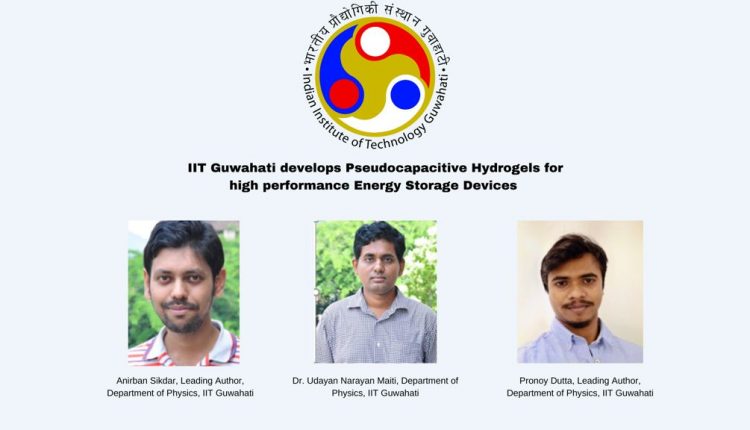
IIT Guwahati Develops Pseudocapacitive Hydrogels For High Performance Energy Storage Devices

August 25, 2021
IIT Guwahati

Guwahati: A group of researchers from Indian Institute of Technology Guwahati have successfully developed hydrogel-based electrodes that could enhance the performance of an energy storage device.

The research group at Department of Physics, IIT Guwahati led by Dr. Uday Narayan Maiti, in collaboration with Prof. Subhradip Ghosh, IIT Guwahati and Dr. N. Padma of Physics group, Bhabha Atomic Research Centre (BARC), Mumbai, under BRNS (Board of Research in Nuclear Science) project has developed a new soft hybrid material, known as hydrogel, to increase the energy storage performance of supercapacitor devices.

A hydrogel is a porous framework of interconnected materials, in which water remains stably locked within the pores. As a building block of the hydrogel, they have chosen two different kinds of nanosheets, namely graphene and MXene, which store charge via two different mechanisms.

Highlighting the unique aspects of the research, Dr. Uday Narayan Maiti, Department of Physics, IIT Guwahati, “Most important aspect of this development lies in its extreme simplicity, scalability and mainly room temperature process which prevents the temperature sensitive MXene from changing its conducting property which ensures high device performance”

He further added, “The entire process of hydrogel development is like constructing a large building with bricks as building blocks. However, development of hydrogels for energy storage using nanosheets require multi-level tuning starting from electronic properties, surface chemical properties and mutual interactions. In our hydrogel structure large graphene sheets provide mechanical stability to the hydrogels, whereas synergistic electronic properties of graphene and MXene give excellent energy storage performance. We believe this development can serve as a platform for further exploration in the area of energy storage devices and beyond.”

In Supercapacitors two electrodes (anode and cathode), made of suitable materials, are immersed within electrolyte solution, and energy is stored by charge accumulation on the electrode surfaces. Atomic-thin sheet-like materials, known as nanosheets, are considered as the best choice for supercapacitor electrode as they can offer a large area to store charge. However, integrating microscopic ultra-small nanosheets into usable macroscopic scales is highly challenging.

They have developed the hydrogels electrodes by simple room temperature process in which graphene and MXene spontaneously assemble themselves over metal plates within a water medium. This unique structure can avoid the restacking challenge associated with charge-storing nanosheets. Graphene, a single atom thin carbon sheet, stores charge on its surface via physical adsorption, known as electrical double layer mechanism (EDLC). Whereas, MXene, nanosheets of titanium carbide, stores charge via both EDLC and chemical reaction on its surface, known as pseudo-capacitance

Researchers at IIT Guwahati showed that their supercapacitors based on MXene-graphene hydrogels can be repeatedly charged and discharged for over 10000 times, with only minimal performance degradation. Such durability is much better than the conventional batteries that typically wear out within 300-500 charging-discharging cycles. The supercapacitor devices developed in the lab can be charged in seconds to their full capacity. It can store energy as high as 30 Wh per kilogram of the materials, which is one of the best values reported to date in MXene based systems. Importantly, these supercapacitors can deliver the energy at a very fast rate when required, which is presented in terms of power density. They have achieved a highest power density of 1.13 kW per kg of electrode material which is almost twice the power offered by current Li-ion batteries. Their hydrogel devices can be engineered to be compact enough to fit the extreme tight spaces of modern portable electronics, which is gaining increasing popularity among the masses.

The results of these breakthrough work in MXene based supercapacitor technologies were published in “Electrochimica Acta” and “Carbon” recently.

Source: indiaeducationdiary.in

Leave a Reply Cancel reply

Your email address will not be published. Required fields are marked *

Editors Corner

How can Artificial Intelligence tools be a blessing for recruiters?

Will Artificial Intelligence ever match human intelligence?

Artificial Intelligence: Features of peer-to-peer networking

What not to share or ask on Chatgpt?

How can Machine Learning help in detecting and eliminating poverty?

How can Artificial Intelligence help in treating Autism?

Speech Recognition and its Wonders in your corporate life

Most groundbreaking Artificial Intelligence-based gadgets to vouch for in 2023

Recommended News

AI Next

Google: AI From All Perspectives

Alphabet subsidiary Google may have been slower than OpenAI to make its AI capabilities publicly available in the past, but...

by India Next
May 31, 2024
AI Next

US And UK Doctors Think Pfizer Is Setting The Standard For AI And Machine Learning In Drug Discovery

New research from Bryter, which involved over 200 doctors from the US and the UK, including neurologists, hematologists, and oncologists,...

by India Next
May 31, 2024
Solutions

An Agreement Is Signed By MEA, MeitY, And CSC To Offer E-Migration Services Via Shared Service Centers

Three government agencies joined forces to form a synergy in order to deliver eMigrate services through Common Services Centers (CSCs)...

by India Next
May 31, 2024
AI Next

PR Handbook For AI Startups: How To Avoid Traps And Succeed In A Crowded Field

The advent of artificial intelligence has significantly changed the landscape of entrepreneurship. The figures say it all. Global AI startups...

by India Next
May 31, 2024

Related Posts

Energy-storage-is-key-to-unlocking-renewable-power-s-full-potential
Energy Storage

Energy Storage Is Key To Unlocking Renewable Power’s Full Potential

July 22, 2022
EV
Energy Storage

Mahindra Open To Investing In EV Battery Cell Maker To Secure Supplies – CEO

July 11, 2022
Lithium-Ion-Battery
Energy Storage

Sion Power’s Lithium Metal Battery Technology Assessed by Leading Independent Industry Expert

June 15, 2022
coal
Energy Storage

India Heading Towards Another Power Crisis In July-August: Report

May 30, 2022
Load More
Next Post
solar

Renew Power Finishes Merger With Nasdaq-Listed Special Purpose Acquisition Vehicle

IndiaNext Logo
IndiaNext Brings you latest news on artificial intelligence, Healthcare & Energy sector from all top sources in India and across the world.

Recent Posts

Google: AI From All Perspectives

US And UK Doctors Think Pfizer Is Setting The Standard For AI And Machine Learning In Drug Discovery

An Agreement Is Signed By MEA, MeitY, And CSC To Offer E-Migration Services Via Shared Service Centers

PR Handbook For AI Startups: How To Avoid Traps And Succeed In A Crowded Field

OpenAI Creates An AI Safety Committee Following Significant Departures

Tags

  • AI
  • EV
  • Mental WellBeing
  • Clean Energy
  • TeleMedicine
  • Healthcare
  • Electric Vehicles
  • Artificial Intelligence
  • Chatbots
  • Data Science
  • Electric Vehicles
  • Energy Storage
  • Machine Learning
  • Renewable Energy
  • Green Energy
  • Solar Energy
  • Solar Power

Follow us

  • Facebook
  • Linkedin
  • Twitter
© India Next. All Rights Reserved.     |     Privacy Policy      |      Web Design & Digital Marketing by Heeren Tanna
No Result
View All Result
  • About Us
  • Activate
  • Activity
  • Advisory Council
  • Archive
  • Career Page
  • Companies
  • Contact Us
  • cryptodemo
  • Energy next
  • Energy Next Archive
  • Home
  • Interviews
  • Make in India
  • Market
  • Members
  • Mission
  • News
  • News Update
  • People
  • Policy
  • Privacy Policy
  • Register
  • Reports
  • Subscription Page
  • Technology
  • Top 10
  • Videos
  • White Papers
  • Work Culture
  • Write For Us

Welcome Back!

Login to your account below

Forgotten Password?

Retrieve your password

Please enter your username or email address to reset your password.

Log In

Add New Playlist

IndiaNext Logo

Join Our Newsletter

Get daily access to news updates

no spam, we hate it more than you!