
Current directory: /home3/bjinbymy/public_html/indianext/wp-content/mu-plugins How Researchers Are Monitoring Biodiversity From Far Away By ‘Listening To The Forest’ - Companies
Indianext
No Result
View All Result
Subscribe
  • News
    • Project Watch
    • Policy
  • AI Next
  • People
    • Interviews
    • Profiles
  • Companies
  • Make In India
    • Solutions
    • State News
  • About Us
    • Editors Corner
    • Mission
    • Contact Us
    • Work Culture
  • Events
  • Guest post
  • News
    • Project Watch
    • Policy
  • AI Next
  • People
    • Interviews
    • Profiles
  • Companies
  • Make In India
    • Solutions
    • State News
  • About Us
    • Editors Corner
    • Mission
    • Contact Us
    • Work Culture
  • Events
  • Guest post
No Result
View All Result
Latest News on AI, Healthcare & Energy updates in India
No Result
View All Result
Home Companies

How Researchers Are Monitoring Biodiversity From Far Away By ‘Listening To The Forest’

September 27, 2022
Sound-recorder-machine-learning

Researchers have developed a new hands-off approach to monitoring biodiversity, where they use a network of recording devices to record a soundscape of a region. The SAFE (Stability of Altered Forest Ecosystems) Acoustics project uses these sound recorders and machine learning models to monitor for changes in this soundscape over time and get early warnings about the health of various ecosystems.

SAFE Acoustics enables researchers to monitor biodiversity at various locations with minimal human interaction. The technology itself is open-source, and the researchers provide a step-by-step guide to building sound recording devices from scratch using a Raspberry Pi and other components. Alternatively, you can buy a “Bugg” recording device developed by the researchers for the same purpose.

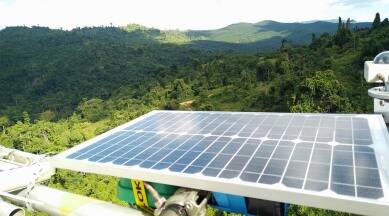
These recorders can record high-resolution audio 24/7, compress them and upload them using solar panels and a battery. After this, cloud-based advanced machine learning algorithms process the sound automatically. The approach begins with the creation of sound reference points, measuring the biodiversity on the ground at the site in question. This is known as “ground-truthing.”

“When we’re trying new technologies for biodiversity monitoring (especially when employing machine learning models), we want to ensure that the results we get are reliable, and line up with previous approaches to monitoring. We normally use “point counts” to ground truth our data, where experienced researchers stand at a fixed point for around 20 minutes and write down every species they see or hear,” Sarab Sethi, who leads the project, told indianexpress.com over email. This data can then be used to train machine learning models to identify changes in the population of different species. Sethi is currently a Herchel Smith Research Fellow at the University of Cambridge.

“The devices were built to withstand long deployments, data is remotely transmitted, and power comes from solar panels. These devices can therefore be permanently deployed, with maintenance only needed rarely. Based on past deployments, this is normally every 6 months, like when an animal disturbs the set-up, but we are always working to make the recorders more reliable and hope to get to deployments of 1-2 years without maintenance,” he added.

The idea with SAFE acoustics is not to replace the need for researchers to go to field sites and record data from there, but to direct limited human resources. Networks of sound records can help gather coarse-level information from a large area. The system can then tell researchers which locations are most at risk, so precious time isn’t spent on surveys in places with no biodiversity change.

“Our recordings have everything from ants, flies, birds, frogs, cicadas, elephants, gibbons, humans, etc. Many species contribute to the soundscape, making it such a rich source of information,” said Sethi.

According to the University of Cambridge, researchers in Norway are using the recorders to monitor the arrival and breeding patterns of migratory birds. Recorders can monitor locations where the bird would have otherwise been missed by researchers who cannot continuously stay on the field. This makes it easier to pick up climate change-driven migration variations.

In Borneo, the recorders are used to monitor areas in various stages of landscape degradation, from old-growth forests to logged forests, to oil palm plantations. Interestingly, recorders are also being used in the Arctic circle to record the noises of agitated ants, which can help detect environmental pollution.

Sarab Sethi led the SAFE Project with supervision from Rob Ewers, Nick Jones and Lorenzo Picinali from Imperial College London. He also worked with David Orme, another researcher at Imperial College London, to develop the technology.

Source: indianexpress.com

Leave a Reply Cancel reply

Your email address will not be published. Required fields are marked *

Editors Corner

How can Artificial Intelligence tools be a blessing for recruiters?

Will Artificial Intelligence ever match human intelligence?

Artificial Intelligence: Features of peer-to-peer networking

What not to share or ask on Chatgpt?

How can Machine Learning help in detecting and eliminating poverty?

How can Artificial Intelligence help in treating Autism?

Speech Recognition and its Wonders in your corporate life

Most groundbreaking Artificial Intelligence-based gadgets to vouch for in 2023

Recommended News

AI Next

Google: AI From All Perspectives

Alphabet subsidiary Google may have been slower than OpenAI to make its AI capabilities publicly available in the past, but...

by India Next
May 31, 2024
AI Next

US And UK Doctors Think Pfizer Is Setting The Standard For AI And Machine Learning In Drug Discovery

New research from Bryter, which involved over 200 doctors from the US and the UK, including neurologists, hematologists, and oncologists,...

by India Next
May 31, 2024
Solutions

An Agreement Is Signed By MEA, MeitY, And CSC To Offer E-Migration Services Via Shared Service Centers

Three government agencies joined forces to form a synergy in order to deliver eMigrate services through Common Services Centers (CSCs)...

by India Next
May 31, 2024
AI Next

PR Handbook For AI Startups: How To Avoid Traps And Succeed In A Crowded Field

The advent of artificial intelligence has significantly changed the landscape of entrepreneurship. The figures say it all. Global AI startups...

by India Next
May 31, 2024

Related Posts

Arm
Companies

Arm And HCLTech To Work Together On Personalized Chips For AI Uses

May 30, 2024
MARS
Companies

MARS Increases Its $50 Million Investment In India’s Infrastructure Market

May 29, 2024
Oncocross
Companies

Oncocross And JW Pharmaceutical Are Extending Their Partnership To Develop Novel Drugs Using Artificial Intelligence For Anticancer And Regenerative Medicine

May 28, 2024
openai
Companies

OpenAI and News Corp. Announce Historic Multi-Year Global Collaboration

May 27, 2024
Load More
Next Post
synthetic data

User Submission: Synthetic Data: Description, Benefits And Implementation

IndiaNext Logo
IndiaNext Brings you latest news on artificial intelligence, Healthcare & Energy sector from all top sources in India and across the world.

Recent Posts

Google: AI From All Perspectives

US And UK Doctors Think Pfizer Is Setting The Standard For AI And Machine Learning In Drug Discovery

An Agreement Is Signed By MEA, MeitY, And CSC To Offer E-Migration Services Via Shared Service Centers

PR Handbook For AI Startups: How To Avoid Traps And Succeed In A Crowded Field

OpenAI Creates An AI Safety Committee Following Significant Departures

Tags

  • AI
  • EV
  • Mental WellBeing
  • Clean Energy
  • TeleMedicine
  • Healthcare
  • Electric Vehicles
  • Artificial Intelligence
  • Chatbots
  • Data Science
  • Electric Vehicles
  • Energy Storage
  • Machine Learning
  • Renewable Energy
  • Green Energy
  • Solar Energy
  • Solar Power

Follow us

  • Facebook
  • Linkedin
  • Twitter
© India Next. All Rights Reserved.     |     Privacy Policy      |      Web Design & Digital Marketing by Heeren Tanna
No Result
View All Result
  • About Us
  • Activate
  • Activity
  • Advisory Council
  • Archive
  • Career Page
  • Companies
  • Contact Us
  • cryptodemo
  • Energy next
  • Energy Next Archive
  • Home
  • Interviews
  • Make in India
  • Market
  • Members
  • Mission
  • News
  • News Update
  • People
  • Policy
  • Privacy Policy
  • Register
  • Reports
  • Subscription Page
  • Technology
  • Top 10
  • Videos
  • White Papers
  • Work Culture
  • Write For Us

Welcome Back!

Login to your account below

Forgotten Password?

Retrieve your password

Please enter your username or email address to reset your password.

Log In

Add New Playlist

IndiaNext Logo

Join Our Newsletter

Get daily access to news updates

no spam, we hate it more than you!