India’s mobility and logistics sector has been among the top sectors that have been hit hardest by the COVID-19 pandemic. The early weeks of the pandemic marked by imposing lockdowns, curfews, and changing consumer behaviour made day-to-day operations for startups and companies operating in the sector – from the fleet providers, logistics companies, aggregators and technology solution providers – extremely challenging. But, at the same time, it also accelerated transformation and opened doors to new opportunities.
At the Digital Pioneers Club CTO Roundtable series, hosted in association with Google Cloud, business and technology leaders from some of the leading startups in the sector came together to share how they leveraged technology, particularly cloud, data and AI to keep the wheels moving for the industry in fast-changing circumstances.
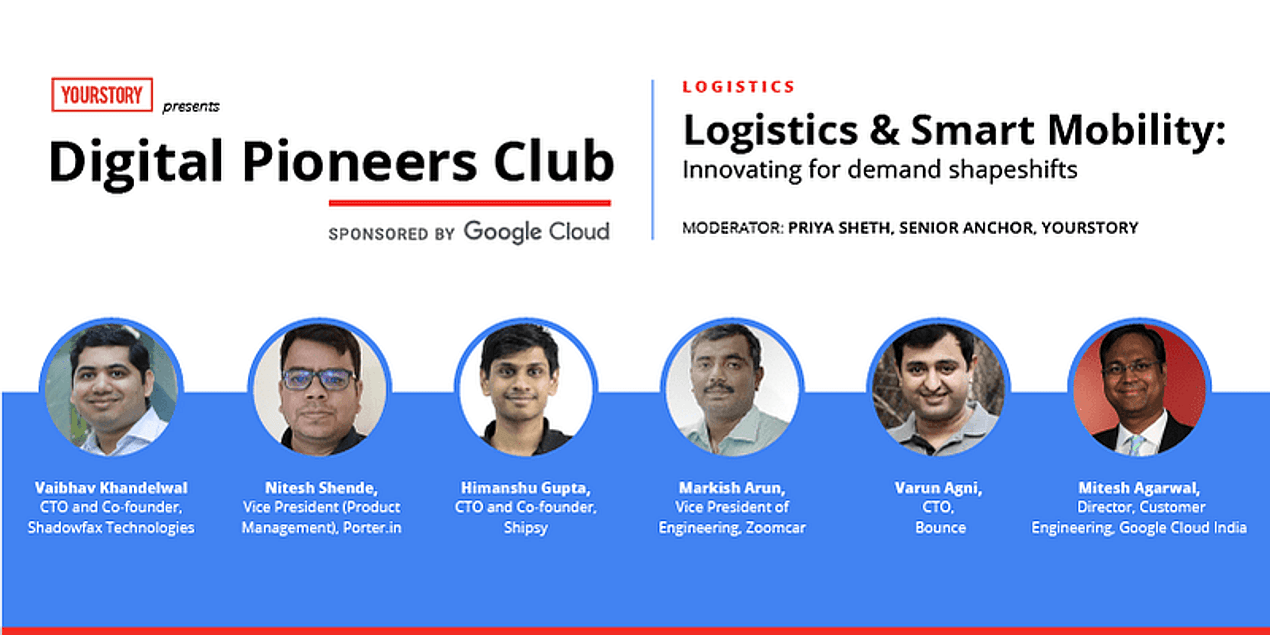
The panel discussion titled ‘Logistics & Smart Mobility: Innovating for demand shapeshifts’ saw
Vaibhav Khandelwal, CTO and Co-founder, Shadowfax; Nitesh Shende, Vice President (Product Management), Porter; Himanshu Gupta, CTO and Co-founder, Shipsy; Markish Arun, Vice President (VP) of Engineering, Zoomcar; Varun Agni, CTO of Bounce and Mitesh Agarwal: Head of Customer Engineering, Google Cloud India coming together to share interesting insights, experiences and perspectives.
Innovating amidst the pandemic
For startups in the last-mile logistics space like Shadowfax Technologies and Porter, the challenges in the initial phase of the lockdown were mostly about the uncertainties with regard to the changing regulations on e-commerce deliveries and intra-city mobility as well as optimising their existing resources to cater to the evolving demand. For instance, when e-commerce deliveries were completely stopped for a few weeks, Shadowfax had to divert its resources from e-commerce delivery to grocery and pharma delivery. And, when the restriction was lifted, the startup witnessed a 3x increase in demand for e-commerce delivery, so it had to once again optimise its resources. “It was constant firefighting. It was challenging to manage the dynamic scenarios and make runtime decisions to meet the business needs while paying equal attention to ensure that the safety of delivery partners, customers was not compromised in the process,” said Shadowfax’s CTO, Vaibhav.
Shipsy’s Himanshu noted that as a technology provider for logistics companies, the company did not have to face operational challenges but had to work towards quickly evolving the platform to meet the needs of its customer base. “Prior to the pandemic, 90 percent of our transactions were geared towards express couriers in the e-commerce category. But, during the pandemic we saw the need to develop technology solutions where logistics companies could experiment with new business models to cater to the demand in grocery and pharmaceuticals. Today, 50 percent of our transactions cater to enabling logistics in the on-demand essentials category,” he said.
For fleet operators such as Bounce and Zoomcar, the mobility challenges induced by the lockdowns and movement restrictions called for acceleration in developing new revenue streams and business models. Bounce, for instance, saw an opportunity to shift to the electric vehicle segment and thus doubled its investments to build new product streams and streamline operations. The CTO of Bounce, Varun shared, “We took the opportunity to change our product offerings to counter the situation and continue the business in new directions.”
Zoomcar’s VP Markish noted that while mobility was among the most affected sectors, it was also one that saw accelerated innovations. For instance, the startup quickly introduced a short-term subscription for its car rentals after observing the changing demand pattern. “So instead of subscribing a car for three months or six months, users could now subscribe to a car for 15 days. Given that people preferred travelling in their own vehicles, we saw a good market response,” he shared. In addition, Zoomcar also partnered with travel vendors like MakeMyTrip to power mobility. This helped to maximise its distribution channel. Given the long-term impact of the pandemic, Zoomcar also kick-started efforts to move into a hybrid model which will be less asset-heavy. “We want to move from being a mobility company to a mobility tech provider with a platform-as-a-service model,” said Markish. He shared that Zoomcar is looking to launch its tech services in a few countries outside India shortly.
Combination of Google Maps, cloud and data
Today Google Maps has become almost like a de facto standard for real-time traffic data, optimised routes and related use cases. Google’s data and analytics and Machine Learning solutions, natural language processing technologies, provide the best technology for fleet operators, logistics aggregators, mobility technology solution providers, and the mobility and logistics industry at large for use cases spanning from route optimisation to shipment visibility, noted Mitesh. He added that its portfolio products under Google Workspace enable greater collaboration and flexibility, paving the way for workforce transformation. Mitesh also explained about Google’s offerings in geospatial data, payments and even Google Search capabilities and how it can play an important role in streamlining operations at different points in the customers’ journey and for different ecosystem players operating in the logistics and mobility sector. “And, all of this is powered by Google Cloud,” he said.
Mitesh outlined three key elements that become important for companies operating in the mobility and logistics space — driver experience via seamless navigation, consumer experience in areas such as shipment tracking and address validation, and fleet optimisation — all of which, he explained, need a significant amount of backend services and data. “So, whether you are using the core Google Maps APIs, route-preferred APIs, or your own fleet routing APIs, there is a lot of data that is being generated. Here, digitisation of logistics planning through machine learning can help because you need to have the ability to process data very fast, scale up or down depending on the data volume in real-time and generate insights in real-time,” he said.
Drawing attention to how companies are able to leverage the power of analytics on the cloud, he pointed to the examples of global companies like United Parcel Service (UPS) in the US and GoJek in Southeast Asia. He shared, “In UPS, we use almost a billion data points per day. And, that includes data points on package weight, shape and size, facility capability across their network. Analysing these data points allows us to minimise forecasting uncertainties.”
As an AI-enabled company that completely runs on the cloud, Himanshu shared that Shipsy leverages AI APIs on Google Cloud for use cases ranging from task allocation to route optimisation strategy. He added that the key advantage of leveraging the cloud has been creating scalable products. “Shipsy has been growing at a rate of 80 to 100 percent, year on year. And, the reason we have been able to handle this scale of growth is because we were able to create our cloud infrastructure in such a way that it auto scales with demand,” he said. He added that being on Google Cloud also enabled the team to iterate its products at a rapid pace and ensured that the product and engineering teams’ focus and efforts stayed on developing solutions for new use cases or solving business problems while the maintenance and routine aspects of technology administration was taken care of by the cloud provider.
Varun explained how Bounce was able to leverage data to enhance user experience, drive business operations and decisions and also create social impact amidst the pandemic. “Collecting data points on how and where our new users were using Bounce and mapping it out, we could get clear indications on where we should operate or focus on distribution of the bikes. Because, the data we had collected in the past was no longer valid,” he explained. He added that the team also built Atlas, an in-house platform based on Google Maps and open source admin platform to provide people real-time information on availability of hospital beds, oxygen, and also vaccination slots.
Future of mobility and logistics
Responding to how deeper integrations with AI and ML would drive new efficiencies and help identify new business opportunities, the startup leaders expressed that areas such as task allocation and optimisation, route optimisation, redistribution of operations, predictive maintenance, shipment visibility, last-mile delivery, among others would increasingly see the need for disruptions and innovations.
Source: yourstory.com