
Artificial intelligence (AI) is able to recognise the biological activity of natural products in a targeted manner, as researchers at ETH Zurich have demonstrated. Moreover, AI helps to find molecules that have the same effect as a natural substance but are easier to manufacture. This opens up huge possibilities for drug discovery, which also have potential to rewrite the rulebook for pharmaceutical research.
Nature has a vast store of medicinal substances. “Over 50 percent of all drugs today are inspired by nature,” says Gisbert Schneider, Professor of Computer-Assisted Drug Design at ETH Zurich. Nevertheless, he is convinced that we have tapped only a fraction of the potential of natural products. Together with his team, he has successfully demonstrated how artificial intelligence (AI) methods can be used in a targeted manner to find new pharmaceutical applications for natural products. Furthermore, AI methods are capable of helping to find alternatives to these compounds that have the same effect but are much easier and therefore cheaper to manufacture.
Target molecules of natural substances
And so the ETH researchers are paving the way for an important medical advance: we currently have only about 4,000 basically different medicines in total. In contrast, estimates of the number of human proteins reach up to 400,000, each of which could be a target for a drug. There are good reasons for Schneider’s focus on nature in the search for new pharmaceutical agents. “Most natural products are by definition potential active ingredients that have been selected via evolutionary mechanisms,” he says.
Whereas scientists used to trawl collections of natural products on the search for new drugs, Schneider and his team have flipped the script: first, they look for possible target molecules, typically proteins, of natural products so as to identify the pharmacologically relevant compounds. “The chances of finding medically meaningful pairs of active ingredient and target protein are much greater using this method than with conventional screening,” Schneider says.
Tested with a bacterial molecule
The ETH chemists tested their concept with marinopyrrole A, a bacterial molecule that is known to have antibiotic, anti-inflammatory and anti-cancer properties. However, there had been limited research into which proteins in the human body the natural substance interacts with to produce these effects.
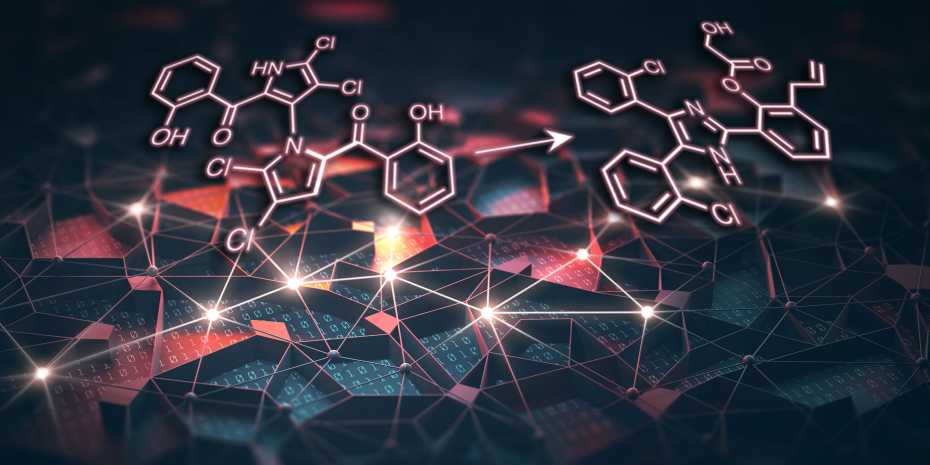
To find possible target proteins of marinopyrrole A, the researchers used an algorithm they developed themselves. Employing machine learning models, the algorithm compared the pharmacologically interesting parts of marinopyrrole A with the corresponding patterns of known drugs for which the target proteins to which they bind are known. Based on the pattern matches, the researchers were able to identify eight human receptors and enzymes to which the bacterial molecule could bind. These receptors and enzymes are involved, among other things, in inflammation and pain processes and in the immune system.
Laboratory experiments confirmed that marinopyrrole A did in fact generate measurable interactions with most of the predicted proteins. “Our AI method is able to narrow down the protein targets of natural products with a reliability often in excess of 50 percent, which simplifies the search for new pharmaceutically active agents,” Schneider says.
Creating a cheap alternative
But the work of Schneider’s research group was not over. If the findings about the target proteins of marinopyrrole A are to result in a useful treatment in the future, it is necessary to find a molecule that is easy to manufacture. After all, marinopyrrole A – like many other natural substances – has a relatively complicated structure, which makes laboratory synthesis time-consuming and expensive.
To search for a simpler chemical compound with the same effect, the ETH researchers used yet another algorithm they designed themselves. This AI program was tasked with being a “virtual chemist” and finding molecules that have similar chemical functionalities to the natural model despite having a different structure. According to the constraints of the algorithm, it also had to be possible to make the molecules in a maximum of three synthesis steps, ensuring easy, low-cost production.
New chemical structures with the same effect
To define the synthesis path, the software had access to a catalogue of over 200 starting materials, 25,000 purchasable chemical building blocks and 58 established reaction schemes. After each reaction step, the program selected as the starting material for the next step the variants that matched marinopyrrole A most closely in terms of functionalities.
In total, the algorithm found 802 suitable molecules, based on 334 different scaffolds. The researchers synthesized the best four in the laboratory and discovered that they actually behaved very similarly to the natural model. They had a comparable effect on seven of the eight target proteins identified by the algorithm.
Subsequently, the researchers investigated the most promising molecule in detail. X-ray structure analyses showed that the compter-generated compound binds to the active centre of a target protein in much the same way as known inhibitors of this enzyme. Despite its different structure, then, the molecule found by AI works using the same mechanism.
Effects on pharmaceutical research
“Our work proves that AI algorithms can be employed in a targeted manner to design active ingredients with the same effects as natural substances, but with simpler structures,” Schneider says, adding: “This helps not only to manufacture new drugs, but also places us on the cusp of a potentially fundamental change in medical-chemical research.” That is to say, the ETH research group’s methods make it possible to find drugs that do the same things as existing drugs but are based on different structures. This could make it easier in future to design new unpatented molecular structures. There is currently intense debate regarding both the extent to which AI could be used to systematically circumvent patent protection and the possible patenting of molecules designed by “creative” AI. In any case, the pharmaceutical industry will have to adapt its research approach to a new rulebook.
Source: ethz.ch