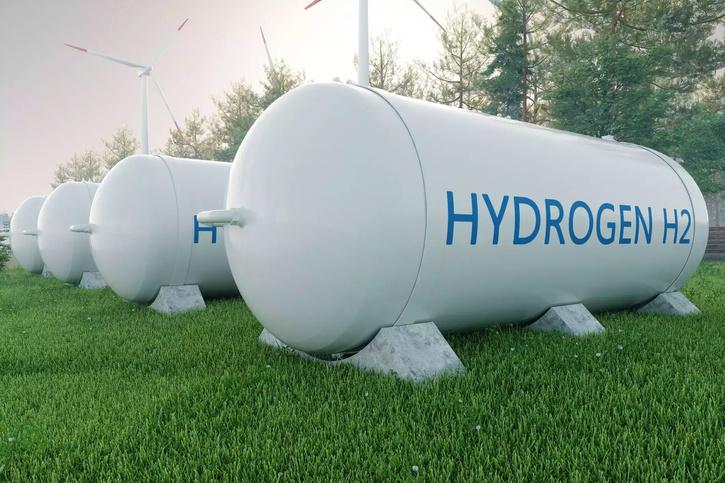
The Indian government has recently announced its national green hydrogen policy, which includes a 25-year exemption of interstate transmission fees for green hydrogen and green ammonia businesses. This exemption would apply to projects completed until June 30, 2025.
The government also plans to produce five million tonnes of green hydrogen per year by 2030, according to the power ministry, in order to achieve its climate goals and establish itself as a manufacturing and trade hub for the fuel.
This target is 50% of the European Union’s goal of producing 10 million tonnes of hydrogen from renewable energy by 2030.
The country with a population more than 3 times that of the EU, has significantly lower per capita power consumption than the EU, but has one of the world ‘s fastest percentage of energy demand increase.
What is green hydrogen?
The most basic and smallest component in the periodic table is hydrogen. It produces the same carbon-free molecule regardless of how it is generated. However, the methods for producing it, as well as the emissions of greenhouse gases such as carbon dioxide (CO2) and methane (CH4), are quite varied.
Green hydrogen is hydrogen created by breaking water into hydrogen and oxygen through renewable energy.
Hydrogen fuel can be utilised as a source of energy in transport, electricity production, and industry activity. It does not produce greenhouse emissions like carbon dioxide when consumed. Green hydrogen is a term used to describe hydrogen gas created using renewable sources of energy such as wind or solar power, which emits no greenhouse gases. Green hydrogen, however, follows a different course than grey or blue hydrogen.
According to a recent government announcement, hydrogen and ammonia are “envisioned to be the potential fuels to replace fossil fuels,” and “generation of these fuels utilising renewable energy (RE) is among the primary considerations towards ecologically friendly energy security of the country.”
What makes it different from standard high-emissions ‘grey’ and blue hydrogen?
Grey hydrogen is usually made from methane (CH4), which is divided by steaming into CO2 (the primary cause of global warming) and H2 (hydrogen). Grey hydrogen is rapidly being created from coal, resulting in much higher CO2 released per unit of hydrogen generated, to the point where it is generally called brown or black hydrogen instead of grey hydrogen.
According to reports, It is now manufactured on a large scale, with emissions equivalent to the aggregate emissions of the United Kingdom and Indonesia. It has no power transmission value at all, quite the contrary.
Presently, because all of India’s hydrogen is nearly exclusively generated from natural gas, a fossil fuel, through a method named as steam-reforming, – which utilises around 6 million tonnes per year – is grey.
Blue hydrogen uses a similar method as grey hydrogen, but with the added technology of capturing and storing the CO2 created as and when hydrogen is separated from methane (or coal).
It’s not just one tone, but a range of shades, because not all CO2 created can be collected, and not all methods of storing it are equally fruitful in the long run. The essential idea is that by absorbing a big portion of CO2, hydrogen production’s climatic impact may be significantly decreased.
Green hydrogen, however, is produced using renewable energy sources such as solar panels and wind turbines. The hydrogen produced is also green because the power source is green. This is why different nations are rushing to include “green hydrogen” in their clean energy initiatives. In August of last year, Prime Minister Narendra Modi unveiled the ‘National Hydrogen Mission,’ with the goal of making India a “green hydrogen hub,” or a prominent producer and exporter of “green hydrogen.”
Green hydrogen in businesses and the transport industry, according to experts, has the potential to significantly reduce India’s carbon emissions, moving the country closer to its climate goals.
What are the key takeaways of India’s Green Hydrogen Policy?
India has set a goal of installing 500 gigawatts (GW) of renewable energy capacity by 2030, with around 280 GW using solar and 140 GW by wind. Additional technologies, like green hydrogen and off-shore wind, are also becoming increasingly important.
Any new clean and renewable energy facilities built to produce power for green hydrogen generation before July 2025 will receive 25 years of free power transmission under the new policy. As a result, a green hydrogen manufacturer in one state of the country will be able to build a solar power plant to provide renewable energy to a green hydrogen factory in another state. It would be exempt from paying interstate transmission fees.
Transitioning to green hydrogen and green ammonia is also “one of the primary prerequisites for reducing emissions, notably in the hard to subside sectors,” according to the green hydrogen policy. Green hydrogen/ammonia producers are permitted to buy renewable energy from the “grid connection or established renewable energy capacity directly or via anyone else, developer, wherever,” as per the policy.
The policy emphasised that green hydrogen/ammonia producers may bank “unused renewable electricity, up to 30 days, with distribution firms and take it back when needed” to promote them. As a result, the government plans to create a single gateway for all clearances needed to start producing green hydrogen.
The demand for time-bound approvals for these facilities would attract participation, while prioritising grid connectivity would simplify administrative operations. It further said that “green hydrogen/ammonia producers and renewable energy units will be offered grid connectivity on a preferential basis to minimise any administrative delays.”
According to the policy, renewable energy dissipated for the development of green hydrogen/ammonia counts toward “Renewable Purchase Obligation (RPO) complying of the consumption institution,” and renewable energy absorbed beyond the producer’s obligation counts toward RPO compliance of distributor in the program’s location.
Significance of the Policy
GHP measures are expected to cut down the price of green hydrogen generation by 40-50 percent, according to India’s leading oil refiner, Indian Oil Corp (IOC). Green Hydrogen and Green Ammonia, according to experts, are critical for any country’s environmentally friendly energy security.
Experts state that green hydrogen could play a crucial role as a disrupting fuel in India’s shift from oil and coal. India has so far pledged to attain net-zero carbon emissions by 2070. The GHP establishes a solid framework for India’s development of a competitive green hydrogen industry.
Will green hydrogen play a significant role in the energy mix?
According to the International Energy Agency (IEA), hydrogen will have a significant part in the worldwide energy transformation, but it’ll be a minor component. According to the energy watchdog, hydrogen and hydrogen-based fuels will contribute less than 0.1 percent of the overall world energy use in 2020. In a situation wherein the world achieves carbon neutrality by 2050, this is predicted to increase to 10%.
Hydrogen can supplement, but not substitute, other clean energy sources such as solar and wind power, which will continue to be less expensive to manufacture and better suited to large-scale manufacturing for house and factory electrification.
A strong renewable infrastructure, on the other hand, can help scale up the generation of green hydrogen by delivering the electricity required to split water into its constituent parts. “While green hydrogen may not substitute renewable energy, solar energy would substantially facilitate the creation of green hydrogen,” SSV Ramakumar, director of research and development for the Indian Oil Corporation (IOC), told The Third Pole.
Source: indiatimes.com