
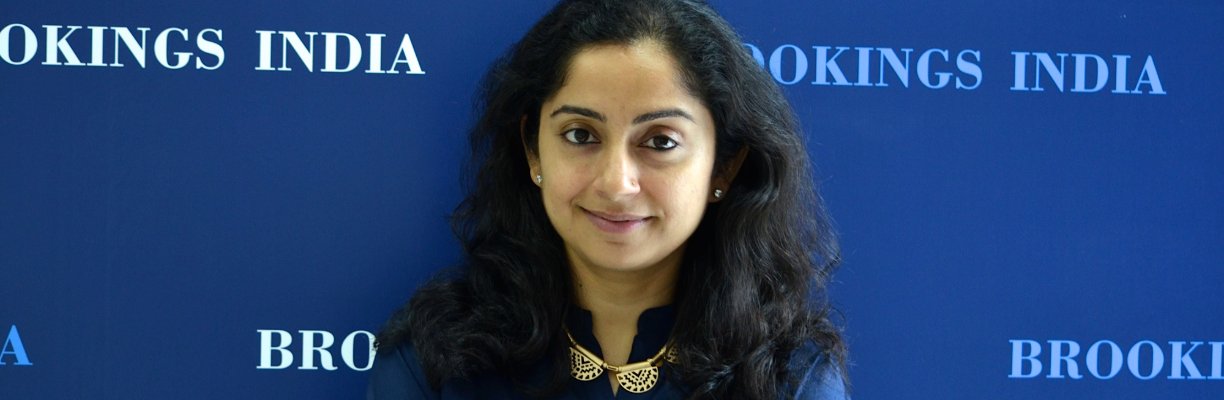
Prof Shamika Ravi is a name that requires no introduction in India’s economic policy and leadership space. Shamika, a renowned economist, is currently the Director of Research at Brookings India as well as the Non-Resident Senior Fellow at Brookings Institute. She is also a former Member Prime Minister’s Economic Advisory Council.
In recent years, Shamika- through her work at Brookings Institute, has emerged as one of the strong voices regarding the economic impact of emerging technologies, specifically Artificial Intelligence. In 2018, she co-authored two reports for the Brookings Institute that brought out many of the economic concerns and realities related to AI in India. INDIAai caught up with Prof Shamika Ravi to understand her thoughts on overcoming India’s challenges in leveraging AI as a catalyst for economic transformation, especially in the matters of R&D, talent, skilling and COVID induced changes.
Solving India’s R&D conundrum in AI
In a 2018 report Prof Shamika Ravi co-authored with Darrell M. West titled ‘Artificial intelligence and data analytics in India’, the stark reality of low R&D investment in India compared to the competition was revealed. It was reported that India, as of 2018, devoted merely 0.6 per cent of GDP to R&D, which was well below 2.74 per cent of the United States and 2.07 of China. The authors stated in the report that this limited investment has slowed innovation and put the country at an economic disadvantage. According to estimates by the Pricewaterhouse Cooper, AI is set to increase global GDP by $15.7 trillion, by 2030. And India is likely to gain just $957 billion as opposed to China’s $7 trillion and North America’s $3.7 trillion. However, despite what the numbers point to, the key question of the hour is how can we prepare to leverage more from the AI-powered economic growth.
“The problems, as well as the solutions to our AI problems fundamentally depends on R& D at large, especially the constraints we are facing in terms of moving towards a knowledge economy,” pointed out Prof Shamika Ravi.
“This percolates down into every aspect of our economy. The less you invest in knowledge creation, knowledge building, and knowledge dissemination, the more you limit future growth. If you don’t have enough faculty, then you don’t have enough educators. Which then leads to a vicious cycle. As a result, the next generation is also therefore inadequately prepared”, she added.
However, it is an undeniable fact that the large problem has to do with, fundamentally the way our institutions and, our overall policy in terms of the R & D spaces is structured.
“That is one part of the puzzle, however, some of the responsibility rests with the industry too,” as she pointed out the lack of industry-academic collaboration in the country.
“The industry is a very significant partner as far as development in many sectors are concerned. Most of the fundamental research which is more public good in nature will happen from the government institutions. However, the responsibility of transforming the research into adoption, through product development and design lies mostly with the industry.”
As a result of this lack of strong industry-academic partnerships, India is currently lagging the entire life cycle of building a knowledge economy. According to Shamika, to overcome this challenge, we all have to come together, as each has an important role to play.
Bridging India’s skilling gap
Solving the R&D conundrum is just one part of the larger problem. India has to overcome several other hurdles as well. In a nation with millions of youngsters, skilling and talent development is crucial.
India has a large number of graduates from technical programs. According to Union Education Minister’s Dharmendra Pradhan reply In a reply to a Lok Sabha question, as of 2020, India has 22,44, 995 STEM graduates. The data was based on the All India Survey on Higher Education. This means there is a large base of individuals who have the aptitude to work in the AI space.
Nevertheless, according to Shamika Ravi, there lie two major problems when it comes to training them to work in new jobs created by AI. They are low-quality of higher education in India and a significant brain drain from the best institutions.
The 2018 India Skills Report found that only 45 per cent of graduates are employable. For engineering graduates, employability varies between 10 to 40 per cent, depending on the role. As a result, today many companies invest in lengthy training programs, which often retrace basic concepts that should have been taught in college.
“The gap between industry requirement and the talent we produce has become a structural aspect of our labour market right now,” Shamika pointed out.
“There is a growing divide between the degrees that we are handing out and the skillset the market values. That divide is very costly”
” It is costly for students because they are paying for a degree and not really learning the right skills. It is expensive for the market because when they recruit thousands of these students, they have to be retrained over several months.”
“That cost, which is getting privatized can be lowered or gotten rid of if we actually improve the quality of education” she asked.
In 2002, India made primary education a fundamental right. As a result, we were able to bring almost 94 per cent of our children into the classrooms. But then what is the quality of education they all are receiving- inquired Shamika.
“The same logic extends in the higher education space as well, as most of these students coming out with the necessary degrees are not getting the true market value of it. And therefore we need these massive reskilling programs, which is a cost,” she pointed out.
“It is an afterthought because fundamentally we are making up for the gaps in the education sector.”
According to Shamika, the new education policy, which was enacted last year, is a big step in the right direction because it allows states and institutions to develop flexible models and eventually it will be about bringing more and more real skills into the class.
The second challenge when it comes to AI talent is the age-old puzzle of ‘brain drain’. As an anecdote, she points out the famous’ Visa temple’ in Hyderabad – the city is the largest supplier of STEM students to the US.
“It tells us about the aspiration of an average engineer who graduates from the region and is quite well-trained, is to go out to the U S and realise his potential,” said Shamika.
“Of course, there is nothing wrong with it. We should encourage it as it can transform families. However, somewhere it is also a recognition of the fact that there is a big gap at home; that we are not able to retain such talent and provide them with this kind of opportunities here,” she added.
Things have been changing in the last two decades as cities such as Bangalore, Gurgaon, Hyderabad and Chennai have grown in terms of potential for the sector and growth opportunities. But still, India is nowhere close, either the quality or in scale, to what the global markets, particularly the US, and now increasingly Australia and Canada are providing.
Recent years also witnessed waves of ‘reverse brain drain’ in China, However, the question remains on how we can implement the same in India.
“In the initial phase, the Chinese students returned as a result of some degree of coercion. If you look at 20 years back, the Chinese students weren’t sure because they had family back home. Back then Indian students, on average, were looking for an extended stay and eventually get a job in the US.”
“However, the average Chinese student was always ambivalent and there was always this option of going back. It has only grown stronger now which is a testimony to the rise in local job opportunities, which can realize this kind of value,” she explained drawing insights from her days as a research student in the US.
According to her, it is high time that we seriously think of ways in which we can incentivize lots of Indians who want to come back for personal or professional reasons.
“As an emerging market, India is currently providing a lot of opportunities and we saw a huge movement of people in the 90s and 2000 when the whole boom happened in IT space here.”
“But, for that, we need to have a consolidated time-bound strategy. So if the R& D is inbuilt into the economy, we can foster it as we do have the talent across the globe. We should bring them back and ensure the ones who are here stays,” she added.
COVID Impact and changing landscape of India’s AI adoption
According to Shamika, the COVID-19 pandemic is going to reshape the economy as well as investment. And she predicts healthcare will be a space that will drive AI investment as a result.
“In the healthcare space, there is an appetite for investment in AI, notably within the public sector. These are still niche institutions and we cannot generalize and say that a district hospital in UP or Assam is open to deploying AI solution today,” she said.
“We cannot discount the fact that India recognizes AI solutions as not just ones that industry can deploy to lower costs or to become more efficient and profitable, but as a tool for providing solutions to core healthcare problems,” she added.
Access is one of the major problems when it comes to healthcare in India, with almost 50 per cent of villages in states such as UP lacking health centres within five kilometres of a house on average. In fact, for many of these villagers, proper healthcare access means travelling to faraway cities such as Lucknow, Kanpur or even Delhi.
According to Shamika, AI can be one of the major tools in solving this challenge of healthcare access as well as the issues of quality and affordability.
Furthermore, she believes that there is hesitancy when it comes to AI deployment in healthcare.
“One of the reasons why there is hesitancy is also because of the law, especially the legal liabilities, which needs an entire infrastructure,” she stated. “We should develop, legal regulatory framework around the adoption of AI tools in healthcare to overcome this hesitance.”
“I do believe that this pandemic has jolted, a lot of local governments also into recognizing the value of AI tools especially with increasing demand from people for quality healthcare. And, I do see AI in healthcare opening up in a very big way in the public as well as the private space in the next 10 years,” she added.
Source: indiaai.gov.in