
Current directory: /home3/bjinbymy/public_html/indianext/wp-content/mu-plugins AI Discovers New Craters On Mars In Just Five Seconds - AI Next
Indianext
No Result
View All Result
Subscribe
  • News
    • Project Watch
    • Policy
  • AI Next
  • People
    • Interviews
    • Profiles
  • Companies
  • Make In India
    • Solutions
    • State News
  • About Us
    • Editors Corner
    • Mission
    • Contact Us
    • Work Culture
  • Events
  • Guest post
  • News
    • Project Watch
    • Policy
  • AI Next
  • People
    • Interviews
    • Profiles
  • Companies
  • Make In India
    • Solutions
    • State News
  • About Us
    • Editors Corner
    • Mission
    • Contact Us
    • Work Culture
  • Events
  • Guest post
No Result
View All Result
Latest News on AI, Healthcare & Energy updates in India
No Result
View All Result
Home AI Next

AI Discovers New Craters On Mars In Just Five Seconds

August 31, 2021
Crate

If you’ve ever played one of those “spot the difference between these two photos” games, you have something in common with NASA scientists.

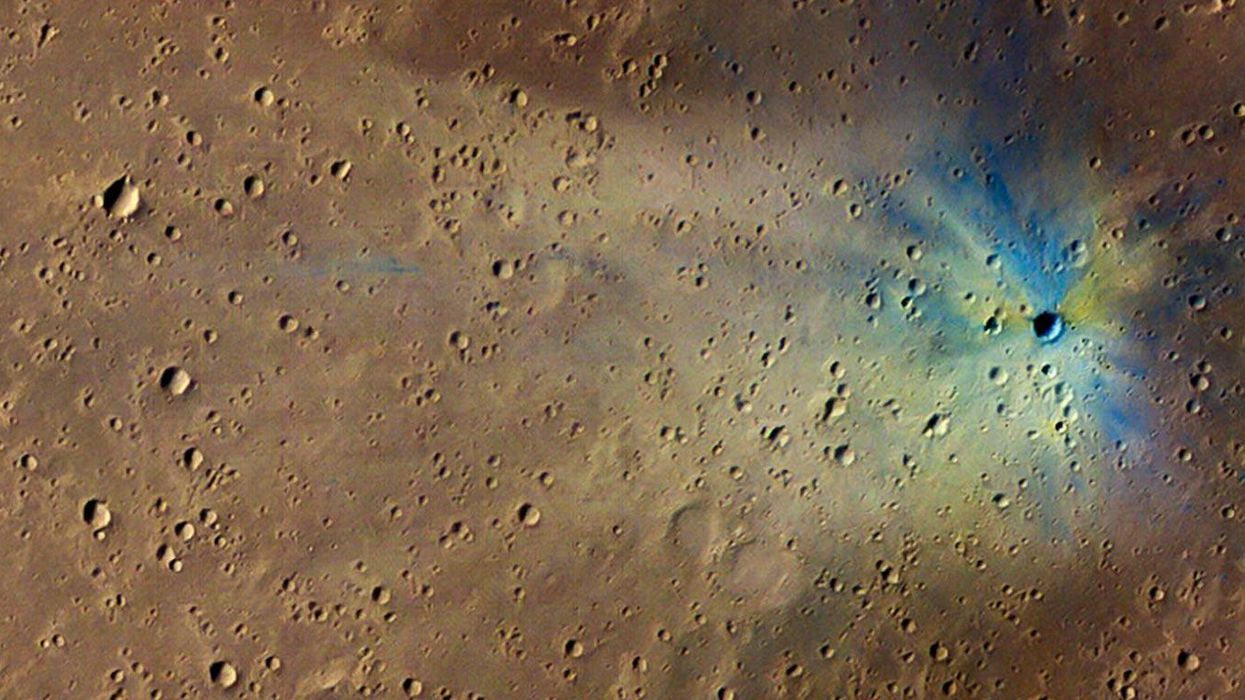
To identify newly formed craters on Mars, they’ll spend about 40 minutes analyzing a single photo of the Martian surface taken by the Context Camera on NASA’s Mars Reconnaissance Orbiter (MRO), looking for a dark patch that wasn’t in earlier photos of the same location.

If a scientist spots the signs of a crater in one of those images, it then has to be confirmed using a higher-resolution photograph taken by another MRO instrument: the High-Resolution Imaging Science Experiment (HiRISE).

This method of spotting new craters on Mars makes it easy to determine an approximate date for when each formed — if a crater wasn’t in a photo from April 2016 but is in one from June 2018, for example, the scientists know it must have formed sometime between those two dates.

By studying the characteristics of the craters whose ages they do know, the scientists can then estimate the ages of older ones. This information can improve their understanding of Mars’ history and help with the planning of new missions to the Red Planet.

The problem: this is incredibly time-consuming.

The MRO has been taking photos of the Red Planet’s surface for 15 years now, and in that time, it has snapped 112,000 lower-resolution images, with each covering hundreds of miles of the Martian surface.

To free scientists from the burden of manually analyzing all those photos, researchers trained an algorithm to scan the same images for signs of new craters on Mars — and it only needs about five seconds per picture.

Fresh craters on Mars

To train their image-analyzing AI to spot new craters on Mars, the researchers started by feeding it nearly 7,000 images from the Context Camera. Some featured fresh craters confirmed by HiRISE photos, and others didn’t.

After training, the next step was letting the algorithm analyze all of the Context Camera images.

This is just beginning. We’re looking forward to finding a lot more.

—INGRID DAUBAR

To speed it up, the researchers ran the AI on a supercomputer cluster at NASA’s Jet Propulsion Laboratory (JPL).

“It wouldn’t be possible to process over 112,000 images in a reasonable amount of time without distributing the work across many computers,” JPL computer scientist Gary Doran said in October. “The strategy is to split the problem into smaller pieces that can be solved in parallel.”

With the power of all those computers combined, the AI could scan an image in an average of just five seconds. If it flagged something that looked like a fresh crater, NASA scientists could then check it out themselves using HiRISE.

Scanning the Martian surface

In October, NASA confirmed that the AI had discovered its first fresh craters on Mars, and to date, it’s helped scientists spot dozens of new impacts in the Context Camera images.

“The data was there all the time,” JPL computer scientist Kiri Wagstaf told Wired. “It’s just that we hadn’t seen it ourselves.”

In the future, the AI might help scientists identify more craters on Mars — potentially within weeks of their formation — or even craters on other planets.

“The possibility of using machine learning to really delve into large data sets and find things that we otherwise wouldn’t have found is really exciting,” Ingrid Daubar, a planetary scientist who helped create the AI, told Wired.

“This is just beginning,” she added. “We’re looking forward to finding a lot more.”

Source: bigthink.com

Leave a Reply Cancel reply

Your email address will not be published. Required fields are marked *

Editors Corner

How can Artificial Intelligence tools be a blessing for recruiters?

Will Artificial Intelligence ever match human intelligence?

Artificial Intelligence: Features of peer-to-peer networking

What not to share or ask on Chatgpt?

How can Machine Learning help in detecting and eliminating poverty?

How can Artificial Intelligence help in treating Autism?

Speech Recognition and its Wonders in your corporate life

Most groundbreaking Artificial Intelligence-based gadgets to vouch for in 2023

Recommended News

AI Next

Google: AI From All Perspectives

Alphabet subsidiary Google may have been slower than OpenAI to make its AI capabilities publicly available in the past, but...

by India Next
May 31, 2024
AI Next

US And UK Doctors Think Pfizer Is Setting The Standard For AI And Machine Learning In Drug Discovery

New research from Bryter, which involved over 200 doctors from the US and the UK, including neurologists, hematologists, and oncologists,...

by India Next
May 31, 2024
Solutions

An Agreement Is Signed By MEA, MeitY, And CSC To Offer E-Migration Services Via Shared Service Centers

Three government agencies joined forces to form a synergy in order to deliver eMigrate services through Common Services Centers (CSCs)...

by India Next
May 31, 2024
AI Next

PR Handbook For AI Startups: How To Avoid Traps And Succeed In A Crowded Field

The advent of artificial intelligence has significantly changed the landscape of entrepreneurship. The figures say it all. Global AI startups...

by India Next
May 31, 2024

Related Posts

Google
AI Next

Google: AI From All Perspectives

May 31, 2024
Pfizer
AI Next

US And UK Doctors Think Pfizer Is Setting The Standard For AI And Machine Learning In Drug Discovery

May 31, 2024
Artificial-Intelligence
AI Next

PR Handbook For AI Startups: How To Avoid Traps And Succeed In A Crowded Field

May 31, 2024
openai
AI Next

OpenAI Creates An AI Safety Committee Following Significant Departures

May 31, 2024
Load More
Next Post
drone

Draconian Provisions Removed, This Drone Policy Is Generating Just The Right Buzz

IndiaNext Logo
IndiaNext Brings you latest news on artificial intelligence, Healthcare & Energy sector from all top sources in India and across the world.

Recent Posts

Google: AI From All Perspectives

US And UK Doctors Think Pfizer Is Setting The Standard For AI And Machine Learning In Drug Discovery

An Agreement Is Signed By MEA, MeitY, And CSC To Offer E-Migration Services Via Shared Service Centers

PR Handbook For AI Startups: How To Avoid Traps And Succeed In A Crowded Field

OpenAI Creates An AI Safety Committee Following Significant Departures

Tags

  • AI
  • EV
  • Mental WellBeing
  • Clean Energy
  • TeleMedicine
  • Healthcare
  • Electric Vehicles
  • Artificial Intelligence
  • Chatbots
  • Data Science
  • Electric Vehicles
  • Energy Storage
  • Machine Learning
  • Renewable Energy
  • Green Energy
  • Solar Energy
  • Solar Power

Follow us

  • Facebook
  • Linkedin
  • Twitter
© India Next. All Rights Reserved.     |     Privacy Policy      |      Web Design & Digital Marketing by Heeren Tanna
No Result
View All Result
  • About Us
  • Activate
  • Activity
  • Advisory Council
  • Archive
  • Career Page
  • Companies
  • Contact Us
  • cryptodemo
  • Energy next
  • Energy Next Archive
  • Home
  • Interviews
  • Make in India
  • Market
  • Members
  • Mission
  • News
  • News Update
  • People
  • Policy
  • Privacy Policy
  • Register
  • Reports
  • Subscription Page
  • Technology
  • Top 10
  • Videos
  • White Papers
  • Work Culture
  • Write For Us

Welcome Back!

Login to your account below

Forgotten Password?

Retrieve your password

Please enter your username or email address to reset your password.

Log In

Add New Playlist

IndiaNext Logo

Join Our Newsletter

Get daily access to news updates

no spam, we hate it more than you!