
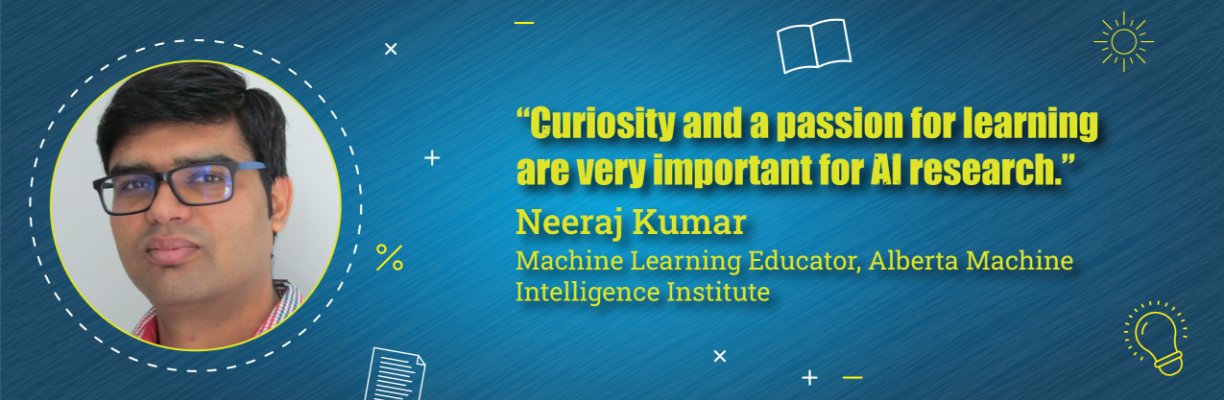
Neeraj Kumar is a Machine Learning Educator at Alberta Machine Intelligence Institute.
He is currently using machine learning algorithms (deep learning, computer vision, and natural language processing) to solve significant problems in digital healthcare.
INDIAai interviewed Neeraj Kumar to get his perspective on AI.
How did you get started with machine learning?
I started in machine learning during my graduate studies at IIT Guwahati. I was fortunate to work with Prof. Amit Sethi (now at IIT Bombay) for my PhD thesis, which was focused on developing machine learning algorithms for computer vision problems. Specifically, I grew learning algorithms for resolution enhancement of natural images that outperformed the benchmark deep learning approaches regarding image reconstruction performance and computational efficiency. I also received numerous awards for my PhD work, including the prestigious Microsoft Research India fellowship and the Erasmus Mundus Heritage fellowship (which allowed me to spend a wonderful semester in France). After graduation, I moved to the USA (and recently to Canada), where I applied machine learning to solve clinically relevant problems at the intersection of healthcare and medicine.
Describe a typical day as a Machine Learning Educator at the Alberta Machine Intelligence Institute (Amii).
As a machine learning educator, I develop and deliver content that enables organizations and individuals to grow their AI literacy and gain the knowledge, skills and abilities they need to be successful in the adoption of AI in their products and services. A typical day at Amii involves:
- Meeting colleagues.
- Brainstorming business problems that can benefit from AI and ML.
- Identifying the knowledge gaps between academic and industrial AI/ML practices.
- Curating resources to upskill the workforce to adopt AI/ML in their business practices.
What were the initial obstacles, and how did you overcome them?
My initial obstacle in applied machine learning research was identifying impactful research problems in medicine and healthcare. It is where we could utilize AI/ML algorithms to obtain meaningful insights from rich and diverse medical datasets, including genomics, medical images (pathology and radiology), personal health records, and longitudinal data. As a result, I established interdisciplinary collaborations with medical professionals to identify clinically relevant research problems, source datasets, and secure funding to accomplish my research objectives.
In my current role, my major obstacle is understanding the knowledge gap between academia and industry to develop user-friendly resources to fill that gap. I regularly meet with my Amii team to build and maintain Amii’s external education initiatives, including providing strategic direction and developing/delivering content.
You mentioned that you have collaborated with clinical and medical professionals to develop machine learning algorithms for individualized survival prediction based on a patient’s clinical data, medical imaging, and genetic data. Can you comment on these algorithms?
Many medical tasks require predicting the time of an individual’s future event(s) – e.g., a patient’s time to death or disease relapse. This “time to an event” task resembles regression – describing a patient, and predicting a non-negative real value (time to death/relapse) – but critically, the training data for survival tasks include censored instances, which provides only a lower bound on the event time. It means most survival prediction models do not estimate a single real value, “time until the event”. Instead, common approaches to survival prediction estimate some other quantity – e.g., a patient’s time-invariant risk score (e.g., Cox proportional hazards model) or their 5-year probability of death (e.g., the Gail model), or perhaps a population’s survival distribution (e.g., Kaplan-Meier curves). In contrast, I focus on survival prediction models that compute individual survival distributions (ISDs) – survival probabilities at all future time points for a specific patient. We have produced ISD models to predict accurately
- time to death or hospital discharge for COVID-19 patients,
- time to breast cancer onset for women enrolled in the Alberta Tomorrow Project, and
- time to death for cancer patients.
We also work on demonstrating how we could translate our results in clinical settings for hospital resource management in emergencies and to provide actionable insights to women to delay their breast cancer onset potentially.
How is India progressing in AI and ML, in your opinion? In this perspective, what would you say are our strengths and weaknesses?
Several Indian institutes, including the IITs, the IIITs, and IISc, have strong AI/ML and data science programs, which help upskill the workforce and provide excellent opportunities to conduct world-class research. Recently, I have also seen strong support from the government of India to fund educational programs on the one hand and encourage entrepreneurship on the other. It has helped create several startups across the country that are solving the most pressing problems in various sectors, including e-commerce, banking, healthcare, and defence. India’s strength lies in its sizeable working-age population of talented young professionals who accept challenges, upskill themselves, and contribute to economic activity through their exceptional work ethics and skills. The recent deployment of 5G infrastructure will accelerate technology adoption across various sectors in urban and rural areas, creating new business opportunities in India. More funding for research, education, and small/medium enterprises, as well as more efficient procedures for government approvals, will help us (read India) grow tremendously in the future.
Tell us about the ongoing AI/ML and data science research at the University of Alberta and Alberta Machine Intelligence Institute.
The University of Alberta (UAlberta) has always been at the forefront of AI and ML. The computing science department at UAlberta and the Alberta Machine Intelligence Institute (Amii) are primarily responsible for cutting-edge research and development in both fundamental and applied aspects of AI/ML. UAlberta’s computing science department has consistently ranked #3 globally in AI/ML for the past 25+ years. Major AI-focused research groups at UAlberta are listed below-
- Board Games Research Group: develops high-performance search algorithms and game-playing programs such as Fuego, the first Go program to beat a top human player in 9×9 Go.
- Games Research Group: engages in the design, analysis, and implementation of artificial intelligence technology that is suitable for use in high-performance game-playing programs.
- Intelligent Reasoning Critiquing and Learning (IRCL) Group: conducts Artificial Intelligence research on real-time heuristic search, interactive story-telling and cognitive modelling. Our recent applications have been with video games. We have ongoing collaborations with the Department of Psychology, UBC Okanagan, Reykjavik University and Disney Research.
- Medical Informatics Group: is involved in a wide range of projects, in collaboration with many teams of medical researchers/clinicians, to produce systems that effectively learn classifiers that make accurate predictions about future patients. We are now dealing with various cancers (breast, brain, leukaemia), transplants, diabetes, stroke, and depression.
Amii is one of three pre-eminent centres of artificial intelligence in Canada that strives to bridge the gap between world-leading AI research and its adoption in the industry.
What do you think will happen to machine learning in the next decade?
Predicted to be one of the world’s most disruptive technologies, AI will transform our world, changing how we live, work and do business. It will change our health and economic, legal, cultural and social environments. AI will touch every industry in the next decade and create over $50 trillion in economic impact. AI adoption in the industry will lead to the development of smart and connected vehicles, smart responsive prosthetics, smart homes, better, more precise diagnostics and the Internet of Things (IoT). AI will significantly influence healthcare, energy, the environment, the digital economy, manufacturing, transportation, finance and more. As a horizontal enabler, AI will impact every business vertical in the next decade, and hopefully, we will set standards for how artificial intelligence can operate safely and transparently soon. There will be processes and laws that will ensure AI’s safe and ethical use in the future.
What advice do you have for individuals who wish to work in artificial intelligence research? What should they concentrate on to advance?
I think curiosity and passion for learning are significant to start a career in the dynamic field of AI research. The AI community welcomes people from different backgrounds, including engineering, sciences, psychology, medicine, etc., and plenty of (online) resources are available to bridge knowledge gaps to transition to AI successfully. One should strive to build strong foundational knowledge in probability, statistics, and machine learning. Since AI has the potential to impact several industries, it is also essential to identify whether an individual prefers to advance AI theory or work on a novel application of AI in their field of interest. Working knowledge of Python programming and familiarity with a few machine/learning libraries (scikit-learn, Tensorflow or Pytorch, Jupyter notebook, etc.) will set you up for success.
Could you please name some significant research publications and books that have impacted you?
I am a big fan of the IEEE Signal Processing Magazine as it publishes tutorial-style articles on signal processing research and applications – beneficial for beginners to understand the latest trends in research.
- Pattern Recognition and Machine Learning by Christopher Bishop is an excellent textbook for a frequentist perspective on machine learning.
- I prefer Kevin Murphy’s Probabilistic Machine Learning: An Introduction from a Bayesian perspective.
- Ian Goodfellow, Yoshua Bengio and Aaron Courville’s Deep Learning book is a good resource for understanding deep learning algorithms.
- I have also enjoyed reading Data Science from Scratch by Joel Grus.
Source: indiaai.gov.in